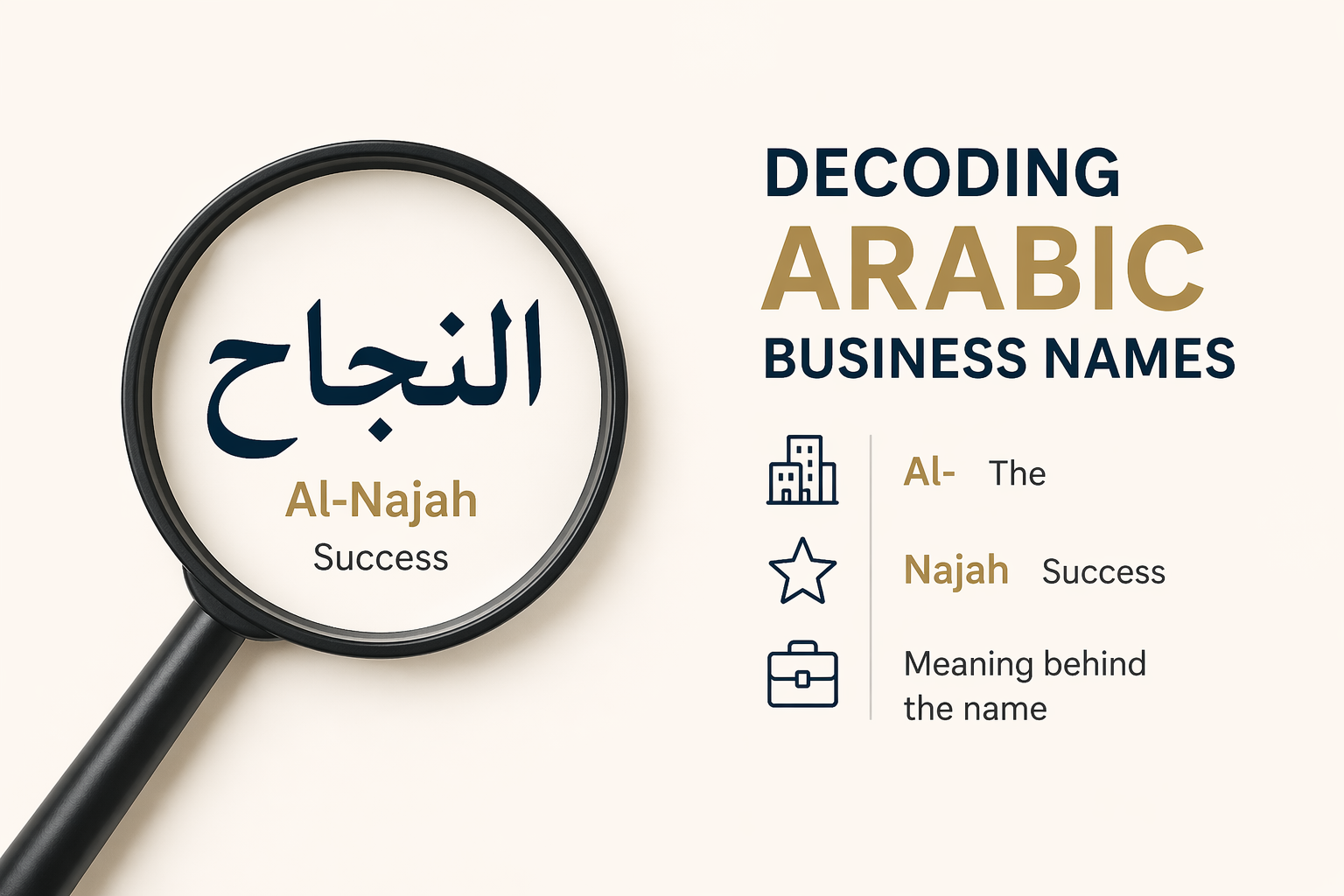
Most Arabic learners hit a wall the first time they try to read a business sign or a letterhead. You can sound out every individual word. You might even know what each one means in isolation. But the name as a whole feels opaque. Why does it open with مكتب? What’s that little ل clinging to the next word? Which part is the family name?
I had this problem for years. Phrasebooks teach you how to greet someone and order coffee. Almost none of them teach you how to read what’s printed on the front of a building.
The good news: Arabic business names are formulaic. Once you can see the formula, the names go from intimidating strings of letters to readable phrases that tell you what the business does, who runs it, and how it presents itself.
The basic anatomy
Most Arabic business names break into three parts:
[entity word] + [proper noun, almost always a family name] + [description of what the entity does]
A generic example:
مكتب الفلاني للمحاماة
Roughly: “Office of [Family Name] for Law.”
Each part does specific work. Let’s take them one at a time.
Part 1: the entity word
The first word tells you what kind of business or organization you’re dealing with. Four show up constantly:
| Arabic | Transliteration | Meaning | Where you’ll see it |
|---|---|---|---|
| مكتب | maktab | office | Lawyers, accountants, engineers, architects, dentists |
| شركة | sharika | company | LLCs, corporations, commercial businesses |
| مؤسسة | mu’assasa | establishment | Sole proprietorships, smaller commercial outfits, some non-profits |
| مجموعة | majmoo’a | group | Holding companies, conglomerates |
The choice isn’t aesthetic. A law practice in Jordan or Egypt is almost always a مكتب and almost never a شركة, because professional licensing rules treat them differently from commercial entities. A construction firm will be a شركة. So the entity word is already telling you something real about the business before you read another character.
Part 2: the family name
The middle slot is usually a family name, and it almost always carries the definite article الـ (al-, “the”). This is a feature of Arabic naming: family names take the article when they function as a label.
You’ll see things like:
- العبويني (al-Abwini)
- الخطيب (al-Khatib)
- الزعبي (al-Zoubi)
- الحموري (al-Hamouri)
When these get transliterated into English the article often drops or hyphenates, so you’ll see “Abwini,” “Al-Khatib,” “El-Hamouri.” In the original Arabic the الـ is part of how the name presents itself on the sign.
A useful rule of thumb: if you see مكتب or شركة followed by a word starting with الـ, that’s almost certainly the founder’s family name.
Part 3: the “for” linker and the descriptor
This is the part most learners stumble on. After the family name you’ll often see a word that begins with لـ (li-, “for”), attached directly to the next word with no space:
- للمحاماة (li-l-muhamah), for law or legal practice
- للاستشارات (li-l-istisharat), for consultations
- للمقاولات (li-l-muqawalat), for contracting
- للتجارة (li-l-tijara), for trade
- للهندسة (li-l-handasa), for engineering
This لـ is the Arabic preposition “for” or “to,” and it fuses with the definite article الـ to give you للـ. So when you parse للمحاماة you’re really seeing ل + ال + محاماة, which is “for + the + law-practice.”
This is where the business description actually lives. The entity word told you what kind of organization it is. The family name told you who runs it. The لـ phrase tells you what they do.
Part 4: compound descriptors with و
Many firms do more than one thing, and Arabic handles that with و (wa, “and”):
- للمحاماة والاستشارات القانونية, for law and legal consultations
- للتجارة والصناعة, for trade and industry
- للمقاولات والإنشاءات, for contracting and construction
The و attaches directly to the following word, no space. The adjective at the end (in the first example, قانونية, “legal”) agrees in gender and definiteness with the noun it modifies.
A worked example
Let’s take a real Jordanian law firm and run it through the framework: مكتب العبويني للمحاماة والاستشارات القانونية.
Going piece by piece:
- مكتب — office. So this is a professional services practice, not a commercial company. That alone tells you it’s licensed under Jordan’s Bar Association rules, not its commercial registry.
- العبويني — al-Abwini. The founder’s family name, with the definite article that family names take in this position.
- للمحاماة — for law. The core service. ل + ال + محاماة.
- و — and. A second service is about to be listed.
- الاستشارات القانونية — the legal consultations. The second service line, with قانونية (“legal,” feminine to agree with استشارات) modifying it.
Full reading: “The Office of al-Abwini for Legal Practice and Legal Consultations.”
Notice how dense the name is. Five words tell you the entity type, the founder’s family, the primary service, and the secondary service. Nothing is decorative. This is one of the things I find satisfying about Arabic professional naming once you can read it: the name is structured information, not branding.
Practice: parse these yourself
Try to break each one into the four parts. Answers below the line.
- شركة الخطيب للمقاولات
- مكتب الزعبي للمحاسبة والتدقيق
- مؤسسة الحموري للتجارة العامة
- مجموعة الفيصل للاستثمار
- Company + al-Khatib + for contracting. A construction firm run by the Khatib family.
- Office + al-Zoubi + for accounting and auditing. An accounting practice.
- Establishment + al-Hamouri + for general trade. A small trading business.
- Group + al-Faisal + for investment. An investment holding company.
What this gets you in practice
Once the pattern clicks, every Arabic letterhead, business directory, and storefront becomes legible. The more practical payoff is search: when you need to look up a specific firm in a court document, an invoice, or a news article, you’ll know which part of the name is the family-name root that actually makes a useful query, and which parts are the descriptive scaffolding around it. Spend an evening reading shop signs in Amman or Cairo with this framework in mind, and the parsing starts happening on its own.