Arabic Learning Resources > Omani Arabic Resources
Omani Arabic is the spoken Arabic of northern Oman and the Hajar mountains, with about 3.2 million speakers according to Ethnologue. It belongs to the Gulf family but keeps features the rest of the Gulf lost. It says -ish for "you" to a woman, mu for "what", and pronounces the letter jim as g, so zawj (husband) is zog.
17 phrases in Omani Arabic, each with the Modern Standard Arabic form where our pages give one. Search them, or compare them with another dialect.
| Meaning | Omani Arabic | Modern Standard Arabic | |
|---|---|---|---|
| hi, welcome (to a man) | حياك hayyak | – | |
| how are you? (to a man) | كيف حالك kef halak | كيف حالك kayfa haluk | |
| how are you? (to a woman) | كيف حالش kef halish | كيف حالك kayfa haluki | |
| what's your news? (to a man) | مو أخبارك mu akhbarak | ما أخبارك ma akhbaruk | |
| fine, praise God | بخير، الحمد لله bi-kher, al-hamdu lillah | بخير، الحمد لله bi-khayr, al-hamdu lillah | |
| thank you, well done (to a man) | أحسنت ahsant | – | |
| good, fine | زين zen | جيد jayyid | |
| what? | مو mu (Muscat and the interior towns) | ماذا matha | |
| why? | ليش lesh | لماذا limatha | |
| I want (said by a man) | باغي baaghi | أريد ureed | |
| I want (said by a woman) | باية baaya | أريد ureed | |
| no, I don't want it (said by a man) | لا، ما باغي la, ma baaghi | لا أريد la urid | |
| now | تو to (Muscat and the interior towns) | الآن al-aan | |
| a lot, very | واجد wagid (Muscat and the interior towns) | كثيرا katheeran | |
| there isn't any | ما شي ma shey | – | |
| is there any? | شي؟ shey? | – | |
| bring me, give me (to a man) | جيب geeb | – |
No phrase matches. Try one word, such as "want" or "where".
Copied from our pages on Omani Arabic, Saudi Arabic, Kuwaiti Arabic, Gulf Arabic, Egyptian Arabic, Common Arabic phrases.
A course built on the wider Khaleeji family Omani sits at the edge of gets you only part of the way, and most schools in Oman teach Modern Standard Arabic (MSA), not the dialect.
How to read the Arabic. Script first, then transliteration, in the scheme of our Emirati page: kh as in Scottish loch, gh a gargled r, ch as in church, ʿ the throat squeeze of ع. Omani flattens ay and aw, so we write kef and zog. Most forms come from Roberta Morano's 2019 Leeds thesis on the dialect of al-ʿAwabi, which summarises Clive Holes' 1989 dialect survey, and a 2020 British Omani Society article by an Omani teacher. Unsourced rows were dropped.
Where Omani Arabic is spoken
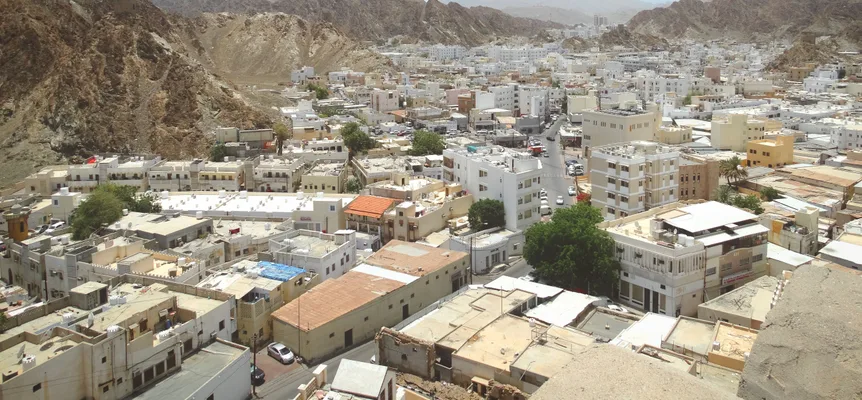
Omani Arabic is spoken from Muscat and the Batinah coast up into the Hajar mountains, including the part of the range inside the UAE. Ethnologue (27th edition, code acx) counts about 3.2 million speakers, a 2020 figure. It also survives in Zanzibar, which an Omani dynasty ruled until 1964.
Just over half the people you meet are Omani: the National Centre for Statistics and Information counted 3,077,081 Omanis and 2,372,884 expatriates on 23 September 2026, about 56.5% Omani.
Two regions speak something else. Ethnologue lists Dhofari Arabic around Salalah (code adf, about 125,000 speakers) and Shihhi Arabic in Musandam (code ssh, about 38,000) as separate varieties. Dhofar also has Mehri and Jibbali, which are not Arabic at all, and borders Yemeni Arabic, Dhofar's neighbour to the west.
Is Omani Arabic closer to MSA?
In a few sounds and forms, yes, but not overall. Google's AI summary repeats a "closest dialect to MSA" line from the Noor Majan Institute, a Muscat school that sells MSA courses.
For the claim: almost all Omani dialects keep the th sounds of ث and ذ, an internal passive and feminine plural verbs, and settled speakers keep qaf as q. Holes credits decades of isolation. Against it: jim is g, "you" to a woman is -ish, verb form IV has nearly gone, and nunation, the -un/-in ending of MSA nouns, is "almost completely absent" (Morano, p. 95). Omani also puts -inn- between a participle and its object, which MSA never does. See how Arabic grammar fits together before the dialect layer. MSA helps you read Omani; it will not teach you to speak it.
Muscat, the interior and the Bedouin: how Omani varies
The real split runs between settled and Bedouin-type speech, not coast and interior. Muscat and interior towns like Nizwa are both settled and both keep q; coastal Sur and parts of the Batinah are Bedouin-type. Some mountain villages turn qaf into k.
| Meaning | Settled: Muscat and interior towns | Hajar mountain villages | Bedouin-type: Sur, Sharqiyya, desert | Source |
|---|---|---|---|---|
| coffee | قهوة qahwa | قهوة kahwa (west and south of Jabal Akhdar) | قهوة gahwa; ghawa near the UAE | Holes 1989, in Morano pp. 42-43 |
| husband (the jim sound) | زوج zog | زوج zog | j in Sharqiyya, y in some western tribes | BOS 2020; Morano p. 42 |
| how are you? (to a woman) | كيف حالش kef halish | كيف حالش kef halish | كيف حالج kef halich (north-east); kef halik (Al Wahiba) | BOS 2020; Morano p. 41 |
| we drank it | نشربه nishribuh | نشربه nishribuh | نشربه nishribah | Morano pp. 43-44 |
| he eats | ياكل yokil | ياكل yokil | ياكل yakil | Morano pp. 43-44 |
| now | تو to | تو to | الحين al-heen | Morano p. 44 |
| what? | مو mu | مو mu | ايش / هيش esh, hesh | Morano pp. 44, 82 |
| who, which (relative) | اللي illi; بو bu in Nizwa, Manah, Ibri | بو bu | not recorded | BOS 2020; Morano p. 82 |
| will (future prefix) | بـ b- in Muscat; أ a- and حـ ha- in Bahla | حـ / هـ ha-, he- (recorded 1894) | not recorded | Morano pp. 46-47 |
| very, a lot | واجد wagid | هست hest (elders only) | واجد wagid | Morano p. 106 |
| room | غرفة ghurfa | حجرة hijra | not recorded | Morano p. 198 |
| sitting room | صالة sala | دهريز dahreez | not recorded | Morano p. 198 |
The last three rows compare al-ʿAwabi town with the villages of Wadi Bani Kharus above it, not with Muscat. Emirati Arabic, which shares the Hajar mountain dialects with Oman, even has the Omani -inn- in Abu Dhabi and Al Ain. The Bedouin column points toward the Peninsular Bedouin dialects inland.
Against the rest of the Gulf: Kuwaitis and Emiratis say -ich to a woman where Omanis say -ish. A Gulf textbook teaches shlonak where Omanis ask kef halak. Emiratis say rah for "go" where most Omanis say sar; in Oman only Buraimi, on the UAE border, says rah. Morano notes younger Omanis drifting toward Gulf forms, which she calls "gulfinisation".
Loanwords in Omani Arabic
Omani Arabic borrowed from Persian, Hindi and Urdu, Swahili and English. Morano recorded every word below in the interior, far from the ports, and each row cites her page.
| Omani word | Meaning | Source language and word | Citation |
|---|---|---|---|
| بندر bandar | bay, as in Bandar Jissah | Persian bandar, port | Morano 2019, p. 213 |
| بيدار beedar | palm-garden worker | Persian bidar, awake | Morano 2019, p. 213 |
| دريشة dreesha | window | Persian, same word | Morano 2019, p. 213 |
| تفق tefaq | gun | Persian tofang, matchlock | Morano 2019, p. 213 |
| هست hest | very, a lot (old-fashioned) | Persian hast, there is | Morano 2019, pp. 213-214 |
| بنكة banka | fan | Hindi pankha | Morano 2019, p. 216 |
| كرفاية kurfaya | bed | Hindi charpai, "four legs" | Morano 2019, p. 216 |
| جوتي gooti | laced shoe | Urdu juti | Morano 2019, p. 216 |
| تيتون teetoon | newborn | Swahili toto, small child | Morano 2019, p. 217 |
| مكبة mkebbe | round plastic food box | Swahili mkebe, tin | Morano 2019, p. 217 |
| بيبي beebee | grandmother, old lady | Swahili bibi | Reinhardt 1894, in Morano 2019, p. 217 |
| سيكل seekil | bicycle | English cycle | Morano 2019, p. 219 |
| دريول draywal | driver | English driver | Morano 2019, p. 219 |
Morano's guess for beedar: the palm-garden workers also kept watch at night. Baluchi has no row, on purpose. Brockett argued in 1985 that Persian words arrived through Baluchi; Morano says there is too little data on Omani Baluchi to test that (p. 212), and we found no published list of Baluchi loans. Swahili is thin too: Morano found only a handful of words despite Oman's long rule over Zanzibar.
Essential Omani Arabic phrases
Hi in Omani is hayyak حياك, roughly "welcome to you", said after as-salamu ʿalaykum. "How are you?" is kef halak to a man and kef halish to a woman. The greetings come from a list Noor Majan helped compile for Beyond the Route; the rest are from Morano and the blog Oman Coast.
| English | Omani Arabic | Transliteration |
|---|---|---|
| Peace be upon you (reply: wa ʿalaykum as-salam) | السلام عليكم | as-salamu ʿalaykum |
| Hi, welcome (to a man) | حياك | hayyak |
| What's your news? (to a man / to a woman) | مو أخبارك / مو أخبارش | mu akhbarak / mu akhbarish |
| How are you? (to a man / to a woman) | كيف حالك / كيف حالش | kef halak / kef halish |
| Fine, praise God | بخير، الحمد لله | bi-kher, al-hamdu lillah |
| Thank you, well done (to a man / to a woman) | أحسنت / أحسنتي | ahsant / ahsanti |
| I want (said by a man / by a woman) | باغي / باية | baaghi / baaya |
| No, I don't want it (said by a man) | لا، ما باغي | la, ma baaghi |
| Is there any? / There isn't any | شي؟ / ما شي | shey? / ma shey |
| Bring me, give me (to a man / to a woman) | جيب / جيبي | geeb / geebi |
| Why? | ليش / امو | lesh / amu |
| Good, fine, OK | زين | zen |
Holes records ahsant as thank you, but Morano's speakers use it more as "well done", so keep shukran ready.
How to learn Omani Arabic
Few courses teach Omani itself: most schools in Oman teach MSA and offer the dialect as an extra. We checked each option on 26 September 2026; prices change, so confirm with the provider.
| Resource | Format | Teaches Omani? | Price (checked 2026-09-26) | Our verdict |
|---|---|---|---|---|
| Omani Arabic (omaniarabic.com) | Evening groups, private and corporate classes | Yes: spoken Omani, native-speaker teachers, per its site | Not published | The only dialect school on Google's first page. |
| Noor Majan Arabic Institute, Muscat and Nizwa | Intensive, 25 hours a week | Not by default: the core is MSA (Al-Kitaab); Omani is "a separate class" on request | From OMR 250 a week (about US$650 by the school's figure); housing extra | Good MSA immersion. Ask for the dialect class. |
| British Omani Society Arabic Language Scheme, Manah | Three-month residential summer course | Partly: mainly MSA, plus Omani dialect classes | Free for 10 scholars; British nationals, mid-advanced; 2026 intake closed | The best deal in Oman if you qualify. |
| Morano, Diachronic Variation in the Omani Arabic Vernacular of the Al-ʿAwabi District (2022) | Academic grammar and glossary | Yes, interior Omani | Free, open access | Not a course; the richest free source of Omani forms. |
| Colloquial Arabic of the Gulf (Holes); Complete Spoken Arabic of the Gulf | Textbooks with audio | No: shared Gulf standard | Varies by seller | Gulf grammar, but no -ish, mu or to. |
| Talkio AI, Omani Arabic | AI chatbot covering 70 languages | Unverified: no Omani-specific material shown | Paid after a 7-day trial; no public prices | Rejected. A beginner cannot tell Omani output from generic Gulf. |
Learn Gulf grammar from a book, then have an Omani correct you. Kuwaiti, the Gulf variety best served by textbooks, supplies most of the grammar, and Qatari Arabic, the Gulf dialect most learners meet in Doha, shows how far Gulf speech has moved from Oman. For the Omani layer, use tutor platforms where you can filter for Omani teachers, naming Muscat or the interior. Still choosing? Compare every other Arabic dialect we cover first.
Frequently asked questions
Is Omani Arabic different?
Yes, enough that general Gulf material will not cover it. Omani Arabic says -ish for you to a woman where Kuwaitis and Emiratis say -ich, uses mu for what and to for now, pronounces the letter jim as g, and keeps an internal passive most Gulf speech has lost. A Kuwaiti or Emirati follows it, but a learner trained on a Gulf textbook will miss these forms.
Are Omani people Arabic?
Most Omanis are Arabs and speak Arabic at home, and Arabic is the official language. Oman is also more multilingual than any other Gulf state. A survey cited by the linguist Roberta Morano lists twelve languages spoken as a first language there, among them Baluchi, Swahili, Gujarati, and Mehri and Jibbali in Dhofar, which are Semitic languages but not Arabic.
How do you say hi in Omani?
As-salamu alaykum works with anyone and is answered with wa alaykum as-salam. The warmer Omani greeting is hayyak, roughly welcome to you, said to a man. Follow it with mu akhbarak, what is your news, or kef halak, how are you. To a woman, the ending changes to -ish: kef halish.
What language does Omani speak?
Omanis speak Omani Arabic, which Ethnologue counts at about 3.2 million speakers, and use Modern Standard Arabic for school, news and official writing. Around Salalah people speak Dhofari Arabic, and in Musandam Shihhi Arabic, which Ethnologue lists as separate varieties. English is common at work, since about 44% of residents are expatriates.
Is Omani Arabic closer to Modern Standard Arabic?
In a few sounds and forms, yes. Settled speakers keep the q of qaf and the th sounds, and Omani keeps an internal passive and feminine plural verbs, all of which MSA has. But Omani pronounces jim as g, says -ish for you to a woman, has almost lost nunation and uses local words like mu and to. It is not a shortcut to MSA, or the reverse.