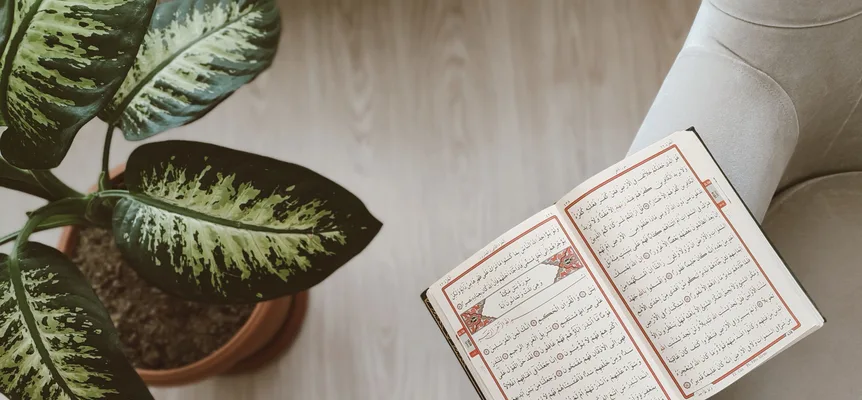
To read Arabic, learn the 28 letters in families of look-alike shapes, give each one its sound, and learn how they join. Then read short words with every vowel marked, time yourself reading whole pages aloud, and finally read the same text with the marks taken away. By our estimate the first three steps take about two weeks.
Level 1: Letters and short vowels
Say the sound of each letter, not its name. Start on the right.
-
ب ت ث
b, t, th: bāʾ, tāʾ, thāʾ: one shape, told apart by the dots
-
ج ح خ
j, ḥ, kh: jīm, ḥāʾ, khāʾ: a dot inside, no dot, a dot above
-
ا د ذ ر ز و
ā, d, dh, r, z, w: alif, dāl, dhāl, rāʾ, zāy, wāw: the six letters that never join the letter after them
-
بَ بِ بُ
ba, bi, bu: bāʾ with the three short vowels: fatḥa, kasra, ḍamma
-
بَا بِي بُو
bā, bī, bū: the same three vowels made long with alif, yāʾ and wāw
Level 2: Words with every vowel marked
Read each word aloud before you check it.
-
بَاب
bāb: door
-
قَمَر
qamar: moon
-
وَلَد
walad: child
-
بَيْت
bayt: house The sukūn on yāʾ means no vowel follows it.
-
شَمْس
shams: sun
-
كَتَبَ
kataba: he wrote
-
كِتَاب
kitāb: book
-
مَدْرَسَة
madrasa: school The final ة is said as a when the word ends a phrase.
-
سَيَّارَة
sayyāra: car The shadda doubles the yāʾ: sayy-.
Level 3: The same words with no vowels
Same words, new order, marks gone. This is how most printed Arabic looks.
-
شمس
shams: sun
-
كتاب
kitāb: book
-
باب
bāb: door
-
سيارة
sayyāra: car
-
ولد
walad: child
-
مدرسة
madrasa: school
-
قمر
qamar: moon
-
كتب
kataba: he wrote The same three letters also spell kutub, books. Without the marks, only the sentence tells you which.
-
بيت
bayt: house
Level 4: A sentence, marked and then bare
One everyday sentence and one verse of the Quran. Read the marked line first.
-
أُرِيدُ أَنْ أَلْعَبَ مَعَ أَوْلَادِكَ
urīdu an alʿaba maʿa awlādika: I want to play with your children.
-
أريد أن ألعب مع أولادك
urīdu an alʿaba maʿa awlādika: I want to play with your children.
-
قُلْ هُوَ اللَّهُ أَحَدٌ
qul huwa llāhu aḥad: Say, He is Allah, [who is] One. (Quran 112:1) Written aḥadun; the ending drops when you stop at the end of the verse.
-
قل هو الله أحد
qul huwa llāhu aḥad: Say, He is Allah, [who is] One. (Quran 112:1)
Words are shown in their dictionary form, without grammatical case endings. Nothing you mark leaves your browser, and the marks clear when you reload.
The drill follows the six steps below, in the same order. Read each line aloud first, then reveal the transliteration and mark it honestly. The timer is for step 5. Every vowelled word is spelled as in its Wiktionary entry (for example كتاب (kitāb, book) and سيارة (sayyāra, car)), the sentence is the usage example on Wiktionary's entry for walad, and the verse is Surah Al-Ikhlas, verse 1, as printed on Quran.com.
One transliteration scheme is used on this page: long vowels are written ā ī ū, ʿ is the letter ʿayn, ʾ is hamza, and a dot under ḥ ṣ ḍ ṭ ẓ marks the heavy letters English does not have.
The site's owner started the same way: letters first, then reading. In the owner's words, "In 2014 I decided to start learning Arabic all over again: I wanted to learn how to read and understand the Quran in Arabic." A family member tutored them: "Every single weekday for over a year we would have lessons over Skype." And "Our first mission was to learn the Alphabet." The owner's full account of learning Arabic as an adult covers what came after it.
What you need before you start
You need about 30 minutes a day, a source of audio for the letter sounds, something to write in, a flashcard app and one fully vowelled text to read from. Only the alphabet book has to cost money.
- Audio for the sounds. This page has no audio. You need to hear each letter said correctly at least once, from a teacher, a course or a book that comes with recordings. Our list of Arabic alphabet books and courses sorts them out. The site's owner wrote: "I started learning from a book called Al-Qaidah An-Noraniah. It is an Arabic Alphabet book that focuses on teaching the proper pronunciation of letters."
- Somewhere to write. The owner's account puts it plainly: "In addition, I used a workbook to practice writing the Arabic letters. You can use almost any Arabic alphabet workbook, just find one that suits you the best." Our free printable Arabic letter worksheets give you a tracing page for each of the 28 letters.
- A flashcard app. We use Anki, which schedules each card's next review for when you are most likely to forget it. The method is called spaced repetition. The Android app, AnkiDroid, is free; the official iPhone app is a paid purchase.
- One vowelled text. Pick something printed with every vowel mark: a children's reader, the first volume of a textbook, or the Quran. You will read the same page many times, so pick something you want to read.
The six steps at a glance
Reading Arabic is six skills learned in a fixed order, and each one has a test you can pass before moving on. The table gives the test and how long we expect each step to take at 30 minutes a day. The times are our estimates, not measurements, and your speed will differ.
| Step | What you do | You are done when | Our estimate |
|---|---|---|---|
| 1. Shapes | Learn the letters in families that share a shape and differ only in their dots | You can name the sound of every letter in random order, including the dot-only pairs | 5 to 7 days |
| 2. Sounds | Say every letter with each short vowel: ba, bi, bu | You read a letter's sound before you think of its name | 4 to 5 days |
| 3. Joining | Learn the four positional forms and the six letters that never join forward | You can point to each letter inside a joined word | 3 to 4 days |
| 4. Vowelled words | Read short words aloud with every mark printed | You read level 2 of the drill without opening a single transliteration | 1 to 2 weeks |
| 5. Speed | Read one vowelled page aloud every session and time it | Your time on the page keeps falling, session after session | Months; the longest step |
| 6. No vowels | Read text you already know with the marks covered, then new unvowelled text | You read levels 3 and 4 of the drill bare, and predict the marks before you look | Covering starts when your speed levels off; new bare text after a first grammar book |
Steps 1 to 3 add up to the two weeks for the alphabet in our six-stage roadmap for learning Arabic. This page is the detailed version of that first stretch, and of the reading practice that follows it.
Step 1: Learn the letter shapes in families
Learn the letters as groups of look-alike shapes, not one by one in dictionary order. Many Arabic letters share one body and differ only in the number and position of their dots: ب ت ث (b, t, th) are one shape with one dot below, two above and three above. Learning the shape once and then the dots is faster than learning three separate letters.
Our Arabic alphabet chart with all four letter forms lists every family, and the eight letters that have no twin. Work through one family a day. Write each letter by hand while you say its sound, because recognising a shape on a screen does not teach your hand where the letter starts.
Fix two things on day one. Arabic runs right to left, so a line starts at the right edge, and a book opens from what an English reader thinks of as the back. And the dots are not decoration. The most common misreading at this stage is reading the right shape with the wrong dots, so look at the dots first.
The letters in your book will be printed in Naskh, the plain style used for most books and newspapers. Handwriting and display lettering can look quite different, and it helps to see the same Arabic letters in other typefaces once Naskh is easy. When you think you know them all, test yourself on the letters with our Arabic alphabet quiz. Level 1 of the drill above is this step.
Step 2: Put a sound to every letter
Say every letter with each of the three short vowels, out loud, until the sound comes to you before the letter's name does. بَ is ba, بِ is bi and بُ is bu. Then do the same with every other letter. You will say the name bāʾ almost never, and the sound b in thousands of words.
Most of the 28 letters have a close English match. Eleven sounds do not, and those are the ones to learn from audio rather than from a description. Our guide to pronouncing the Arabic letters English does not have explains where in the mouth each one is made and gives word pairs to test yourself on. Pronunciation is what Al-Qaidah An-Noraniah focuses on, and this is the step where a teacher's ear matters most.
Do this in a fixed order. The short vowels a i u first, then the long ones: the same letter followed by alif, yāʾ or wāw gives bā, bī, bū. The last two lines of level 1 in the drill are exactly this.
Step 3: Learn how the letters join
Learn the four shapes each letter takes, depending on whether it stands alone or sits at the start, middle or end of a word, and learn which six letters refuse to join forward. Arabic has no separate print and cursive. Every printed word is joined up, so you cannot read a word until you can find the letters inside it.
Most letters connect to the letter before them and the letter after them. Six connect only to the letter before them: ا د ذ ر ز و (ā, d, dh, r, z, w). After one of these the next letter starts fresh, which is why a short word often looks like two or three separate pieces. بَاب (bāb, door) is written as two pieces: با (bā) and then ب on its own, because alif cannot join the bāʾ after it.
One combination has its own shape. When lām is followed by alif, the two are always written as the single sign لا, which on its own is the word lā, meaning "no". Beginners often take it for a letter they have not met.
Don't learn the alphabet chart's positional forms cell by cell. Pick a word from your text, find each letter in it, and say which form it is in. Ten words a day for three or four days does the job.
Step 4: Read short words with every vowel marked
Read short, fully vowelled words aloud, and check the transliteration only after you have said the word. The vowel marks tell you exactly how to say every word, so at this step you can read Arabic you do not understand yet. You decode first and understand later.
Four more signs appear at this step. The small circle called sukūn means no vowel follows the letter, as in بَيْت (bayt, house). The shadda, a small w-like mark, means the letter is said twice, as in سَيَّارَة (sayyāra, car). Alif, wāw and yāʾ after a short vowel make it long. And ة, the tāʾ marbūṭa at the end of many feminine words, is said as a at the end of a phrase. Our chart of every Arabic vowel mark on one letter has the full set, including the three tanwīn endings this page leaves out.
Level 2 of the drill is graded in that order: three letters with short vowels (qamar, walad), then sukūn (bayt, shams), then a long vowel (kitāb), then shadda (sayyāra). When a word stops you, check which of those four signs caused it and practise that sign.
Put every word you miss into Anki, with the Arabic on the front and the sound on the back. The owner's account says: "My tutor introduced me to the concept of spaced repetition." And: "I used this space repetition technique for every step along the way: Alphabet, reading words, learning vocabulary, and memorizing grammar rules."
Step 5: Read whole pages aloud and time yourself
Choose one fully vowelled page, read it aloud at every session, and write down how long it took. Reading speed is the honest measure of whether the letters have landed, because it is a number you can watch fall.
The owner's account describes doing exactly this: "After learning the letters, we started reading the Quran. To measure progress, we timed how long it took to read a page in the Quran. At first, it would take 20 minutes to read a single page! Eventually, my reading increased to only taking 2 minutes to read a single page." A stopwatch is all it takes to collect the same numbers for yourself.
Use the timer at the top of the drill, or any stopwatch. Three rules make the number mean something:
- Read every word aloud. Silent reading lets you skip a word you cannot sound out without noticing.
- Keep the same page for a week before you change it, so the time measures your reading rather than a new page's difficulty.
- Read to someone now and then. A tutor or teacher hears mistakes you cannot. The owner's account notes that "As my reading speed increased, my tutor introduced different tajweed rules", the rules for reciting the Quran, and recommends a colour-coded Quran for learning them.
A children's reader or a beginner textbook works the same way, as long as every word carries its marks.
Step 6: Take the vowel marks away
Start reading without the vowel marks by re-reading text you have already read with them, covering the marks and checking yourself after each line. Begin this as soon as your timed page stops getting faster. New unvowelled text comes later. This is the step that turns reading the script into reading Arabic, because newspapers, novels, signs and phone messages print almost no short vowels.
Without the marks, a word's letters can stand for more than one word. كتب can be كَتَبَ (kataba, he wrote) or كُتُب (kutub, books). A reader knows which from the rest of the sentence, and that takes grammar and vocabulary. So reading new bare text starts properly once you have worked through a first grammar book, and it improves for as long as you read.
Level 3 of the drill gives you the level 2 words with their marks removed and their order changed, so you cannot just remember the sequence. Level 4 does the same with a sentence. Our page on which Arabic texts print the vowel marks lists what you can read early and what stays out of reach until this step.
Common mistakes when learning to read Arabic
The mistakes that hold beginners back are mostly habits, not problems with the letters.
- Reading the transliteration first. If your eyes go to the English letters, they never learn the Arabic ones. In the drill, read the line before you reveal it, every time. Past the first two weeks, stop using transliteration at all.
- Learning names instead of sounds. Knowing that ج is called jīm does not help you read جَ as ja.
- Skipping the dots. ب (b) and ت (t) differ only by their dots, and so do ح (ḥ) and خ (kh). Slow down at every dotted letter.
- Staying on vowelled text too long. Fast reading with every mark printed is fluent reading of the marks, nothing more. Once your timed page stops getting faster, start covering them.
- Going without guidance. The site's owner wrote: "I tried many times previously to learn Arabic but I would always fail miserably because I had zero guidance on where to start." What changed it, in the same account, was a tutor who "was able to guide me along the way and show me what resources I should use to achieve my goals."
What to do next
When you can read the bare lines of the drill and your timed page has stopped getting faster, reading is no longer the thing to work on. The next step is the language itself. Our roadmap for what to learn after the alphabet picks a grammar book, a tutor and an app for each stage.
If the letters still trip you up, go back to the Arabic alphabet quiz and drill the dot-only pairs until they stop costing you time. If you would rather learn with a teacher and a syllabus than on your own, compare online Arabic courses with a live teacher or a fixed syllabus before you pay for one.
Frequently asked questions
Is it hard to read Arabic?
Reading the script is one of the easier parts of Arabic. There are 28 letters, each with up to four joined shapes, plus a small set of vowel marks, and nothing new is added later. By our estimate, at 30 minutes a day you can sound out fully vowelled words within three or four weeks. The hard part comes after that: reading text printed without the short vowels, which you can only do once you know enough grammar and vocabulary to supply them yourself.
How to learn Arabic easily?
Learn to read first, because every textbook, dictionary and course after that assumes you can. Spend about 30 minutes a day: learn the letters in look-alike families, read short words with every vowel marked, put the words you miss into a spaced-repetition app such as Anki, and read aloud to someone who can correct you. Then choose Modern Standard Arabic or one dialect and work through one book at a time.
How long does it take to learn to read Arabic?
By our estimate, about two weeks at 30 minutes a day to know the letters, their sounds and how they join, and another one to two weeks to sound out short vowelled words. Reading at speed takes far longer. The site's owner timed it: a single page of the Quran took 20 minutes at first and eventually 2. Reading text without vowel marks comes later still, after a first grammar book.
Can I learn to read Arabic on my own?
You can learn the letters and sound out vowelled words on your own with a chart, a workbook, a quiz and a drill like the one on this page. What you cannot do alone is check your pronunciation, because you do not hear your own mistakes. Learn the sounds from a course or book with audio, and read aloud to a tutor or teacher at least now and then.
Should I learn to read Arabic with or without vowels?
With them first, then without. The vowel marks tell a beginner exactly how to say every word, so you can practise reading before you know any grammar. Almost everything printed for adults leaves them out, though, so once you can predict the vowels on text you have read before, start covering them and move on to unvowelled text.