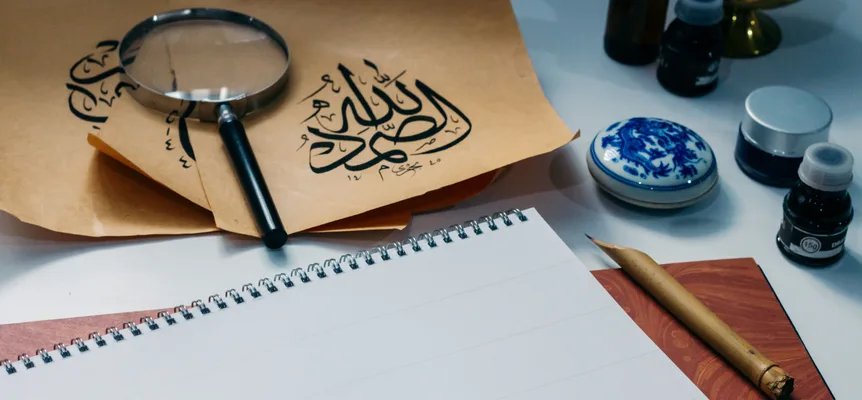
Arabic diacritics, called حَرَكَات (ḥarakāt) or تَشْكِيل (tashkīl), are small marks written above and below the consonants to show the short vowels and a few other sounds. Eight of them are in ordinary use: fatḥa, kasra, ḍamma, sukūn, shadda, and the three tanwīn endings. Every one of them is shown below on the same letter.
The vowel marks are what make case endings visible. Our Arabic grammar basics page explains which endings matter for reading and which the dialects drop.
That last part is the point of this page. Most charts put each mark on a different example word, so you end up hunting for the mark instead of comparing shapes. Here they all sit on ب (bāʾ) and the only thing that changes from row to row is the mark. If you do not yet know the letters underneath, start with our Arabic alphabet chart with every positional form.
The Arabic diacritics chart
Eight marks attach to any consonant in Arabic: three write a short vowel, one writes the absence of a vowel, one doubles the letter, and three are the indefinite noun endings called tanwīn. The host letter in every row below is ب (bāʾ), pronounced like English "b".
| On ب | Name | Transliteration | Sound | Where it sits | Category |
|---|---|---|---|---|---|
| بَ | فَتْحَة fatḥa | ba | short "a", as in "cat" | a short diagonal stroke above the letter | short vowel |
| بِ | كَسْرَة kasra | bi | short "i", as in "bit" | the same stroke, below the letter | short vowel |
| بُ | ضَمَّة ḍamma | bu | short "u", as in "put" | a small wāw-shaped loop above | short vowel |
| بْ | سُكُون sukūn | b | no vowel; the consonant closes the syllable | a small circle above | absence of a vowel |
| بّ | شَدَّة shadda | bb | the consonant held twice as long | a small "w" shape above | doubling |
| بً | فَتْحَتَان fatḥatān | ban | "a" followed by "n" | two fatḥas side by side, above | tanwīn |
| بٍ | كَسْرَتَان kasratān | bin | "i" followed by "n" | two kasras side by side, below | tanwīn |
| بٌ | ضَمَّتَان ḍammatān | bun | "u" followed by "n" | a doubled ḍamma above | tanwīn |
Four more marks matter in ordinary text, and they are the reason a chart of eight feels incomplete once you open a real book. Each of these attaches only to certain letters, so none of them can go on ب, and each is shown here inside a real word instead.
| Name | What it does | Where it can appear | Example | Transliteration | Meaning |
|---|---|---|---|---|---|
| مَدَّة madda | writes a long "ā" where a hamza and an alif would otherwise collide | only on alif | الْقُرْآن | al-Qurʾān | the Quran |
| أَلِف خَنْجَرِيَّة dagger alif | writes a long "ā" that has no alif in the spelling | a short fixed list of very common words | هٰذَا | hādhā | this |
| وَصْلَة waṣla | marks an alif that is written but not pronounced, because the previous word runs into it | on the alif of the definite article and of some verb forms | بِٱسْم | bi-sm | in the name of |
| هَمْزَة hamza | writes a glottal stop, the catch in the middle of English "uh-oh" | alone, or seated on alif, wāw or yāʾ | سَأَلَ | saʾala | he asked |
How to read the chart
Read every mark as belonging to the consonant it sits on, and read it after that consonant, never before. بَ is "ba", not "ab". That is the hardest habit for an English speaker to build, because English writes its vowels in a line and Arabic stacks them. One transliteration scheme runs across this page, the Library of Congress ALA-LC Arabic romanization: a macron for long vowels (ā ī ū), a dot underneath for the emphatics (ḥ ṣ ḍ ṭ), ʿ for ayn and ʾ for hamza.
The marks are also why one set of letters can be four different words. Take كتب as a newspaper prints it, with nothing written on it:
| Vowelled | Transliteration | Meaning | Marks used |
|---|---|---|---|
| كَتَبَ | kataba | he wrote | three fatḥas |
| كُتِبَ | kutiba | it was written | ḍamma, kasra, fatḥa |
| كُتُب | kutub | books | two ḍammas |
| كَاتِب | kātib | writer, clerk | fatḥa, kasra, and a written alif |
A fluent reader picks the right one from the sentence around it in a fraction of a second. A beginner cannot, which is why beginners' material prints the marks and adult material does not.
The three tanwīn endings and the alif seat
Tanwīn is a doubled vowel mark on the last letter of an indefinite noun, and it adds an "n" sound that is written nowhere in the letters. كِتَابٌ (kitābun) is "a book", كِتَابًا (kitāban) is the same word as a direct object, and كِتَابٍ (kitābin) is the form after a preposition. Add the definite article and the tanwīn disappears: الْكِتَاب (al-kitāb), the book.
Notice that one of those three grew an extra alif. Fatḥatān is the only tanwīn that survives when you stop on the word. The "-an" becomes a long "-ā" in pause, and a long vowel needs a letter to carry it, so an alif is written in. The other two simply drop, so they need nothing. That is the whole rule, and it is why شُكْرًا (shukran, thank you) and مَرْحَبًا (marḥaban, welcome) both end in an alif that is not a sound of its own.
Three endings skip the alif, because the word already ends in something that can carry the vowel:
| Word | Transliteration | Meaning | Why no alif |
|---|---|---|---|
| مَدْرَسَةً | madrasatan | a school | ends in tāʾ marbūṭa ة |
| مَاءً | māʾan | water | ends in a hamza that already follows an alif |
| هُدًى | hudan | guidance | ends in alif maqṣūra ى |
Printers disagree about where to put the mark when the alif is there. Most modern typesetting places it on the consonant before the alif, as in كِتَابًا; older and some Egyptian editions place it on the alif itself. Both are read the same way.
These endings are also the grammar: which of the three you use depends on the noun's case, and the same endings mark mood on verbs. That machinery is laid out in the conjugation grid where these endings do the work.
Shadda: one letter written once and said twice
Shadda means the consonant is doubled, and doubling changes meaning rather than just emphasis. دَرَسَ (darasa) is "he studied". Put a shadda on the middle letter and you get دَرَّسَ (darrasa), "he taught". Same three letters, one small mark, opposite side of the classroom. Doubling the middle consonant is a live piece of Arabic word-building, not an accident of spelling.
A shadda never stands alone. It always carries a vowel too, and the two stack:
| On ب | Read as | Example | Transliteration | Meaning |
|---|---|---|---|---|
| بَّ | bba | مُحَمَّد | Muḥammad | Muhammad |
| بِّ | bbi | مُدَرِّس | mudarris | a teacher |
| بُّ | bbu | رَبُّ | rabbu | lord |
Fatḥa and ḍamma sit on top of the shadda. Kasra usually drops below the letter instead, though some printings tuck it just under the shadda; both mean the same thing. The shadda you see in الشَّمْس (al-shams, the sun) is a different phenomenon again, the definite article's lām assimilating into the letter after it, which the alphabet chart linked above covers in full.
Which Arabic texts actually print harakat
Whether an Arabic text prints harakat is settled by what kind of text it is, not by the writer's preference. The Quran is fully vowelled, always, and so are children's books and school primers. Poetry, dictionaries and printed religious material carry the marks in places. Newspapers, novels, road signs and WhatsApp messages carry none at all, and that last group is most of the Arabic you will ever see.
| Text | Diacritics? | What it means for a learner |
|---|---|---|
| The Quran | Fully, every word | The one text you can read from your first month. Recitation depends on the marks, so no printed muṣḥaf omits them |
| Printed hadith collections | Fully or nearly | Also readable early, though the vocabulary is harder than the Quran's |
| Children's books and school primers | Fully, through roughly grade four | The best graded reading material in the language, and the cheapest |
| Classical poetry, printed editions | Fully or heavily | The meter depends on the case endings, so editors keep them |
| Dictionaries | Headwords only | You cannot look a word up and pronounce it without knowing these marks |
| Textbooks for foreign learners | Fully at first, thinning out by volume three | The taper is deliberate and it is the transition this page is about |
| Religious sermons and mosque notices | Partially | Quranic quotations are vowelled, the surrounding Arabic usually is not |
| Novels and general non-fiction | No, apart from the odd ambiguous word | Off limits until you can supply the vowels yourself |
| Newspapers, online and print | No | The standard test of whether you have made the transition |
| Government forms, road signs, shop signs | No | Real-world Arabic is bare, always |
| WhatsApp, social media, subtitles | Never | Native speakers do not type the marks and will find it odd if you do |
One line in that table is worth reading twice. Short summaries of this topic tend to say that dictionaries are vowelled, and that is only half true: the headword is vowelled and the definition around it is not. It matters, because looking a word up is the single most common reason a learner needs these marks at all.
Read the table as a reading list in order. It is also why reading the Quran, the one text that is always fully vowelled is such a common first target for adult learners: it is the only substantial body of Arabic prose where the pronunciation of every single word is written down for you.
When to stop reading vowelled Arabic
Stop when you can predict the marks before you look at them, which for most learners arrives near the end of a first full grammar course, not at the end of the alphabet. The test is simple and you can run it today: cover the marks on a line you have already read, read it again, then uncover and check. When you are getting the vowels right without thinking, the marks have finished their job.
I learned to read on the Quran, which is fully vowelled from the first page to the last, and my tutor and I timed a page every session. It went from 20 minutes down to 2 over about a year. That number felt like fluency and it was not. It was fluency at reading marks, and the marks were doing work I had not learned to do. Going back and forcing myself onto unvowelled text was slower and much less pleasant than staying where I was comfortable, and it is the step I would take earlier if I did it again.
Two things make the transition survivable. Re-read material you first met vowelled, so you are recalling rather than decoding. And learn the noun and verb patterns properly. Arabic vowels follow templates rather than sitting on each word at random, and once you know the template for "place where something happens" you will never need a mark on مَدْرَسَة (madrasa, school) again. The beginner path from the alphabet onward sets out the order we recommend.
Common mistakes with Arabic diacritics
The mistake that costs beginners the most time is reading the mark before the letter. The mark belongs after its consonant, so كَ is "ka" and never "ak". Say the consonant first, every time, until it is automatic.
Sukūn is not silence. It marks a consonant with no vowel after it, and that consonant is still pronounced, clearly. مَكْتَب (maktab, office) has a fully audible "k".
Do not write the marks into messages to Arabic speakers. Nobody does it, and it reads roughly the way ALL CAPS reads in English. Keep them in your study material.
The slowest mistake is skipping the marks because a course lets you. Some beginner courses run transliteration alongside the script for months. That is a debt, and it comes due the first time you meet a word nobody has transliterated for you. Learn the marks in your first weeks, from a book that drills them. Our list of books for learning the Arabic script covers the ones that do it well.
Frequently asked questions
What are the Arabic diacritics?
Eight marks are in ordinary use. Three short vowels: fatha (a), kasra (i) and damma (u). Sukun, a small circle marking a consonant with no vowel after it. Shadda, which doubles the consonant. And three tanwin endings, fathatan, kasratan and dammatan, which add an n sound to an indefinite noun. Beyond those eight, madda, the dagger alif, wasla and hamza attach only to particular letters.
What is the difference between harakat and tashkeel?
Harakat means the vowel marks specifically: fatha, kasra, damma and, by extension, sukun and the tanwin endings. Tashkeel is the wider word for the whole system of marks written on top of the consonantal skeleton, so it also covers shadda, madda, the dagger alif and wasla. In practice teachers use the two words interchangeably and nobody will misunderstand you either way.
Do I need to learn Arabic diacritics?
Yes, and early. You cannot pronounce a new word correctly without them, and you cannot use a dictionary without them, because dictionary headwords are printed fully vowelled. What you do not need is to keep reading vowelled text forever. Learn the marks in your first weeks, then work steadily towards reading text that does not print them.
Why do Arabic newspapers not print diacritics?
Because a fluent reader does not need them. Arabic words are built on patterns, so the consonants plus the grammar of the sentence usually pin the vowels down without help. Printing the marks on every word would also cost space and typesetting effort for no gain. Newspapers add a mark only where a word would otherwise be genuinely ambiguous.
Why does fathatan sit on an alif?
Because the -an ending is pronounced with a long vowel when you pause on the word, and that long vowel needs an alif to carry it. So kitab becomes kitaban with an alif added at the end. The other two tanwin endings, -un and -in, disappear when you pause, so they need no extra letter. The alif is dropped when the word already ends in ta marbuta, in alif maqsura, or in a hamza that follows an alif.