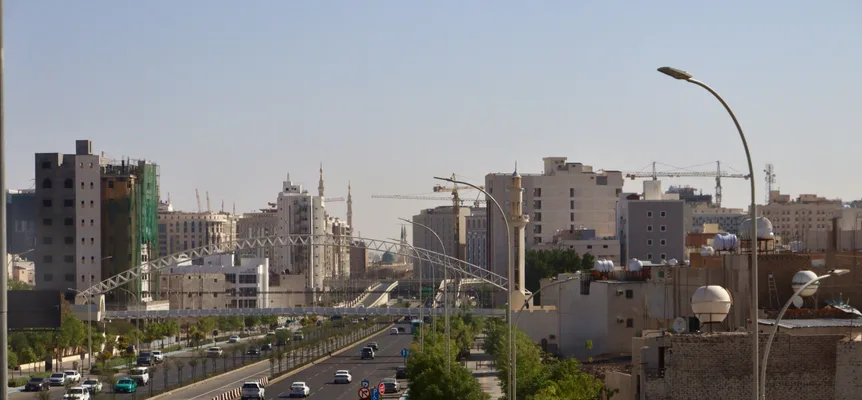
Saudi Arabic splits into three main dialects. Najdi Arabic covers Riyadh and the centre, with 19 million speakers on Ethnologue's 2024 figures; Hejazi Arabic covers Jeddah, Mecca and Medina, with 11 million. Gulf Arabic is spoken in the Eastern Province, and the far south speaks varieties close to Yemeni. Najdi is the prestige form and the one to learn.
20 phrases in Saudi Arabic, each with the Modern Standard Arabic form where our pages give one. Search them, or compare them with another dialect.
| Meaning | Saudi Arabic | Modern Standard Arabic | |
|---|---|---|---|
| hi, good to see you | هلا والله hala wallah | – | |
| how are you? (to a man) | شلونك shlonak (Najdi, Riyadh) | كيف حالك kayfa haluk | |
| how are you? (to a man) | كيف حالك kayf halak (Hejazi, Jeddah) | كيف حالك kayfa haluk | |
| sorry about that, never mind | معليش maʿlesh | – | |
| consider it done | أبشر absher | – | |
| yes | إيه eh (Najdi, Riyadh) | نعم naʿam | |
| yes | إيوه eewa (Hejazi, Jeddah) | نعم naʿam | |
| good, fine | زين zein (Najdi and Hejazi) | جيد jayyid | |
| what? | وش wesh (Najdi, Riyadh) | ماذا matha | |
| what? | إيش esh (Hejazi, Jeddah) | ماذا matha | |
| what is going on? | وش السالفة wesh as-salfa (Najdi, Riyadh) | – | |
| where? | وين wein (Najdi, Riyadh) | أين ayna | |
| where? | فين fein (Hejazi, Jeddah) | أين ayna | |
| why? | ليش lesh (Najdi and Hejazi) | لماذا limatha | |
| how much is this? | بكم هذا bikam hadha | كم ثمن هذا kam thaman hadha | |
| I want | أبي abi (Najdi, Riyadh) | أريد ureed | |
| I want | أبغى abgha (Hejazi, Jeddah) | أريد ureed | |
| I did not understand | ما فهمت ma fahimt | – | |
| now | الحين al-heen (Najdi, Riyadh) | الآن al-ʾan | |
| now | دحين daheen (Hejazi, Jeddah) | الآن al-ʾan |
No phrase matches. Try one word, such as "want" or "where".
Copied from our pages on Saudi Arabic, Common Arabic phrases.
That split is the thing most pages about the Saudi dialect skip. They give you a list of words without saying which half of the country says them, which is how learners end up saying دحين in Riyadh and وش in Jeddah and sounding odd in both. This page sets Najdi and Hejazi against Modern Standard Arabic in one table so you can see exactly where they part company. Speaker figures checked September 2026.
Transliteration. One scheme throughout, the same one used on our page of common Arabic phrases in three dialects. The symbol ʿ is the letter ع, a squeeze in the throat with no English equivalent; ʾ is a glottal stop; kh is the ch of Scottish loch; gh is a gargled r. No dots under the emphatic letters, because the script column is there for anyone who can read them.
Where Saudi Arabic is spoken, and by how many
Four varieties divide the country along geographic lines: Najdi with 19 million speakers, Hejazi with 11 million, Gulf Arabic with only about 200,000 inside Saudi Arabia, and the southern varieties of Asir and Jazan, which Ethnologue does not count separately. Linguists file all of them under Peninsular Arabic, and Ethnologue treats Najdi (ars) and Hejazi (acw) as separate languages with their own ISO codes rather than accents of one Saudi dialect, which tells you how far apart they sit.
| Variety | Where it is spoken | Speakers |
|---|---|---|
| Najdi Arabic (ars) | Riyadh, Al-Qassim, Haʾil and the central plateau, plus tribal areas across the border in Jordan, Iraq and Syria | 19 million, on underlying data from 2018-2023 |
| Hejazi Arabic (acw) | The Red Sea west: Jeddah, Mecca, Medina and partly Taʾif | 11 million, on underlying data from 2018 |
| Gulf Arabic (afb) | The Eastern Province: Dammam, Qatif, Al-Hasa | about 200,000 in Saudi Arabia, out of 11 million worldwide |
| Southern varieties | Asir, Jazan, Najran, Al-Baha, along the Yemeni border | not counted separately by Ethnologue |
Speaker figures are from Ethnologue, 27th edition (2024), which lists Najdi Arabic under the code ars and Hejazi Arabic under acw. The arithmetic is worth looking at, because it does not work the way you would expect. Najdi and Hejazi together come to 30 million, while the 2022 census run by Saudi Arabia's General Authority for Statistics counted 32.2 million residents, of whom 18.8 million were Saudi citizens. The two figures only reconcile if you accept that Najdi is counted well beyond Saudi borders and that long-settled foreign residents are counted as speakers. Treat 19 million and 11 million as the size of each speech community, not as a headcount of Saudis.
Najdi is the prestige variety, and specifically the modern urban dialect of Riyadh. It is the capital's accent, it dominates broadcasting and government, and it is the accent other Saudis adjust toward. If you have no particular city in mind, that is the one to learn.
Najdi vs Hejazi vs Modern Standard Arabic
Najdi and Hejazi diverge most on the words you use hundreds of times a day. What is wesh in Riyadh and esh in Jeddah, now is al-heen against daheen, and I want is abi against abgha. They agree on plenty else, and the table below marks the agreements rather than inventing differences. Read a row across and you have the same idea in three varieties.
| English | Modern Standard Arabic | Najdi (Riyadh, the centre) | Hejazi (Jeddah, Mecca, Medina) |
|---|---|---|---|
| What? | ماذا matha | وش wesh | إيش esh |
| Where? | أين ayna | وين wein | فين fein |
| Why? | لماذا limatha | ليش lesh | ليش lesh |
| Now | الآن al-ʾan | الحين al-heen | دحين daheen |
| I want | أريد ureed | أبي abi | أبغى abgha |
| What do you want? (to a man) | ماذا تريد matha tureed | وش تبي wesh tabi | إيش تبغى esh tabgha |
| How are you? (to a man) | كيف حالك kayfa haluk | شلونك shlonak | كيف حالك kayf halak |
| Yes | نعم naʿam | إيه eh | إيوه eewa |
| Good, fine | جيد jayyid | زين zein | زين zein |
| Like this | هكذا hakadha | كذا kidha | كذا kadha |
| Coffee (shows the qaf) | قهوة qahwa | قهوة gahwa | قهوة gahwa |
| Dog (shows the kaf) | كلب kalb | كلب tsalb, older speakers | كلب kalb |
Two patterns run through that table. The question words split cleanly, so a single sentence tells you which half of the country someone is from. The last two rows are not vocabulary at all: they are the same written word said two ways. That is where most of the distance between Saudi speech and the textbook actually lives.
The sounds that give a Saudi speaker away
Three sound changes account for most of the gap between what you read and what you hear: the qaf is said as a hard g, the kaf can become a ts in Najdi, and Hejazi flattens the two th sounds that Najdi keeps. Learn them and a lot of Saudi speech resolves into words you already know.
The first is qaf. The letter ق, written q and pronounced as a deep k in Modern Standard Arabic, is a plain English g across Najd and the Hejaz, so قهوة is gahwa, not qahwa. Religious and formal vocabulary keeps the classical sound. Nobody says al-gurʾan for القرآن.
The second is kaf, and only in Najdi. In the northern and central dialects ك can turn into a ts sound, so كلب comes out tsalb rather than kalb. It is fading. Riyadh speech is levelling the dialects around it and the affricated forms keep getting rarer among younger speakers, so you will hear this from an older man in Al-Qassim and hardly ever from a student in Riyadh.
The third is the interdentals, where the two dialects go opposite ways. The th of ث and the th of ذ are alive in Najdi, exactly as in Modern Standard Arabic. Many urban Hejazi speakers merge them toward t, d and z instead, the way Cairo and Beirut do. For anyone arriving from Modern Standard Arabic, that makes Najdi the smaller adjustment.
One grammar note is worth having early. Hejazi does not use the -sh ending to negate verbs and does not double its negation, so the Egyptian and Palestinian pattern you may have met in a course does not transfer here.
Essential Saudi Arabic phrases
The phrases below work in both Riyadh and Jeddah unless noted. Four of them carry most of the load: as-salamu ʿalaykum to open, hala wallah for warmth, maʿlesh for every small apology, and absher to accept a favour someone asks of you. Greetings and courtesy formulas are the part of Saudi speech that travels furthest, which is why a visitor gets so much mileage out of so few words.
| English | Arabic | When to use it |
|---|---|---|
| Peace be upon you | السلام عليكم as-salamu ʿalaykum | The greeting, everywhere, to anyone |
| And upon you peace | وعليكم السلام wa ʿalaykum as-salam | The reply, and the only correct one |
| Hi, good to see you | هلا والله hala wallah | Warm and distinctly Saudi, for people you know |
| Welcome to you | هلا فيك hala fik | The answer to hala wallah |
| Good morning | صباح الخير sabah al-khayr | Reply with صباح النور, sabah an-nur |
| How are you? (to a man) | شلونك shlonak | Najdi. In the Hejaz say kayf halak |
| Fine, praise God | الحمد لله al-hamdu lillah | The expected answer, whatever is actually true |
| Sorry (said by a man) | آسف asif | A real apology. A woman says asifa |
| Sorry about that, never mind | معليش maʿlesh | Small apologies and small setbacks, used constantly |
| Thank you | شكرا shukran | Universal |
| May God keep you safe | الله يسلمك allah yisallimak | The warm reply to thanks |
| Consider it done | أبشر absher | Saying yes to a request, very Saudi |
| With pleasure | على راسي ʿala rasi | Literally on my head. Accepting a favour asked of you |
| How much is this? | بكم هذا bikam hadha | Shops and taxis |
| Where is the bathroom? | وين الحمام wein al-hammam | Say fein al-hammam in Jeddah |
| I did not understand | ما فهمت ma fahimt | Better than nodding |
| What is going on? | وش السالفة wesh as-salfa | Najdi, informal, among friends |
How Saudi Arabic differs from Gulf, Emirati and Yemeni Arabic
Saudi speech sits at the centre of the Arabian Peninsula and shades into every dialect around it. Najdi and Khaleeji share the hard g, the word zein for good and most of a core vocabulary, which is why a Riyadh speaker and a Kuwaiti speaker understand each other without effort. Our page on Gulf Arabic covers how Saudi speech sits inside the wider Khaleeji family, including the words a general Gulf course will teach you.
Moving around the Peninsula, the Emirati dialect a Gulf learner meets next is the closest thing to a sibling with a real institute behind it, and Kuwaiti, the Gulf dialect with the most learner material, is the practical fallback when nothing Saudi-specific exists for what you need. To the south, the varieties of Asir and Jazan blend into Yemeni Arabic, just across the southern border, which is why a Jazani speaker can sound more Yemeni than Najdi to an untrained ear.
Which Saudi dialect to learn, and how
Learn Najdi unless you have a specific reason not to. It is the prestige variety, it is understood across the country, and it is the smaller step from Modern Standard Arabic because it keeps the interdental sounds and much of the older vocabulary. Choose Hejazi only if your work or family ties are in Jeddah, Mecca or Medina, and Gulf Arabic if you are heading for the Eastern Province oil towns.
The honest problem is material. Duolingo, Pimsleur and Rosetta Stone all teach Modern Standard Arabic or Egyptian, and none of them offered a Saudi dialect course as of September 2026. No major publisher has one either, the way they have Egyptian and Levantine courses. What exists is a general Gulf textbook, a scattering of specialist websites, and Saudi tutors, which means the realistic plan is a Gulf Arabic course for structure plus a Saudi tutor to convert it into how Riyadh actually speaks. Tell the tutor which city you are targeting in the first session, because a Riyadh tutor and a Jeddah tutor will model different question words at you from day one.
Two things make the gap survivable. Najdi is close enough to Modern Standard Arabic that ordinary MSA study feeds straight into it, unlike Moroccan or Algerian. And Saudi media output is large: Riyadh-based drama, podcasts and YouTube give you more listening hours than almost any dialect this poorly served by textbooks.
If you are still deciding, our comparison of which Arabic dialect to learn and who each one suits weighs Saudi against Egyptian, Levantine and the rest by speaker numbers and material available. For the wider map, see our guide to the Arabic dialect families, and the books, courses and tutor services we recommend are collected on our Arabic learning resources page.
Frequently asked questions
How do you say hi in Saudi Arabia?
The safe greeting is as-salamu alaykum, and the reply is wa alaykum as-salam. The warmer, more distinctly Saudi hello is hala wallah, which lands somewhere between hi and good to see you. The reply to that one is hala fik. In the west around Jeddah and Mecca you will also hear a plain marhaba.
How do you say sorry in Saudi dialect?
For a real apology, say asif if you are a man and asifa if you are a woman. For the small things - bumping someone, arriving late, breaking bad news - Saudis say maalesh, which covers both sorry about that and never mind. Maalesh is used far more often than asif in ordinary conversation.
What is the difference between Najdi and Hejazi Arabic?
Najdi is the speech of Riyadh and the central plateau, Hejazi is the speech of Jeddah, Mecca and Medina. The everyday words split: Najdi says wesh for what, abi for I want and al-heen for now, while Hejazi says esh, abgha and daheen. Najdi keeps the th and dh sounds of Modern Standard Arabic that many Hejazi speakers flatten to t and d.
Is Saudi Arabic the same as Gulf Arabic?
No. Gulf Arabic, or Khaleeji, is a separate variety spoken in Kuwait, Bahrain, Qatar and the Emirates, and inside Saudi Arabia it is native only to the Eastern Province. Ethnologue counts around 200,000 Gulf Arabic speakers in Saudi Arabia against 19 million Najdi speakers. Najdi and Khaleeji share a great deal, so learners move between them easily, but Gulf textbooks do not teach Riyadh speech.
What is the hardest Arabic dialect to learn, and where does Saudi Arabic sit?
Moroccan and Algerian Arabic are the hardest for an English speaker who studied Modern Standard Arabic first, because their vowels, their Berber and French vocabulary and their sentence rhythm all sit a long way from the written language. Saudi Arabic sits at the easy end of that range. Najdi keeps the interdental th and dh sounds of Modern Standard Arabic and shares much of its vocabulary with the written language, so there is less to unlearn. The hard part is not the dialect, it is that almost every published course teaches Egyptian, Levantine or a generic Gulf variety instead.