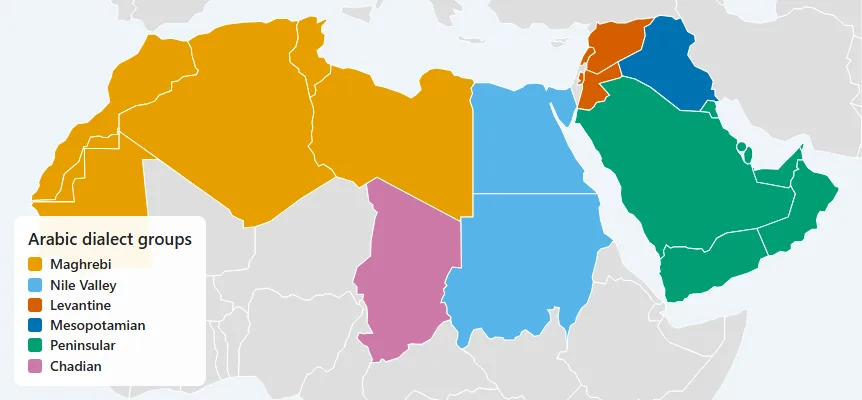
Arabic Dialects > Arabic Dialect Map
Arabic dialects fall into five main groups, and each has its own color on this map of Arabic dialects: Maghrebi across North Africa, Nile Valley in Egypt and Sudan, Levantine in Syria, Lebanon, Jordan and Palestine, Mesopotamian in Iraq, and Peninsular across Arabia. Chadian Arabic has a sixth color. Tap a country to see its dialect and three everyday words.
Tap a country on the map, or pick one from the list, to see its dialect, how many people speak it, and how to say "how are you", "what" and "I want" there.
Morocco
Maghrebi group
Dialect: Moroccan Arabic (Darija)
Moroccan Arabic: 40 million speakers in all countries
- What?
- شنو shno
- I want
- بغيت bghit
Algeria
Maghrebi group
Dialect: Algerian Arabic (Darja)
Algerian Arabic: 42 million speakers in all countries
- What?
- واش wesh
- I want
- نحب nhebb (I like, I want)
Tunisia
Maghrebi group
Dialect: Tunisian Arabic (Tounsi)
Tunisian Arabic: 12.5 million speakers in all countries
- What?
- شنوة shnuwa
- I want
- نحب nheb
Libya
Maghrebi group
Dialect: Libyan Arabic
Libyan Arabic: 6.1 million speakers in all countries
Our dialect pages do not give these three words for this dialect yet.
Mauritania
Maghrebi group
Dialect: Hassaniya Arabic
Hassaniya Arabic: 5.6 million speakers in all countries
Our dialect pages do not give these three words for this dialect yet.
Western Sahara
Maghrebi group
Dialect: Hassaniya Arabic
Hassaniya Arabic: 5.6 million speakers in all countries
Our dialect pages do not give these three words for this dialect yet.
Egypt
Nile Valley group
Dialect: Egyptian Arabic
Egyptian Arabic: 119 million speakers in all countries
- How are you?
- إزيك izzayyak
- What?
- إيه eh
- I want
- عايز ʿayiz
Sudan
Nile Valley group
Dialect: Sudanese Arabic
Sudanese Arabic: 52 million speakers in all countries
- How are you?
- إنت كيف inta keif (to a man)
- What?
- شنو shinu
- I want
- أنا داير ana dayir (said by a man)
Syria
Levantine group
Dialect: Syrian Arabic (Levantine)
Levantine Arabic in Syria: 21 million speakers
- How are you?
- كيفك kifak / kifik (to a man / to a woman)
- What?
- شو shu
- I want
- بدي baddi
Lebanon
Levantine group
Dialect: Lebanese Arabic (Levantine)
Levantine Arabic in Lebanon: 5.4 million speakers
- How are you?
- كيفك kifak / kifik (to a man / to a woman)
- What?
- شو shu
- I want
- بدي baddi
Jordan
Levantine group
Dialect: Jordanian Arabic (Levantine)
Levantine Arabic in Jordan: 12 million speakers
- How are you?
- كيفك keefak
- What?
- شو shu
- I want
- بدي biddi
Palestine
Levantine group
Dialect: Palestinian Arabic (Levantine)
Levantine Arabic in Palestine: 5.0 million speakers
- How are you?
- كيف حالك kif halak (to a man)
- What?
- شو shu
- I want
- بدي biddi
Iraq
Mesopotamian group
Dialect: Iraqi Arabic
Iraqi Arabic: 32 million speakers in all countries
- How are you?
- شلونك shlonak
Kuwait
Peninsular group
Dialect: Kuwaiti Arabic (Gulf)
Gulf Arabic: 11 million speakers in all countries
- How are you?
- شلونك shlonak (to a man)
- What?
- شنو shinu
- I want
- أبي abi
Bahrain
Peninsular group
Dialect: Bahraini Arabic (Gulf)
Gulf Arabic: 11 million speakers in all countries
- How are you?
- شلونك shlonak (to a man)
- What?
- شنو shinu
- I want
- أبي abi
Qatar
Peninsular group
Dialect: Qatari Arabic (Gulf)
Gulf Arabic: 11 million speakers in all countries
- How are you?
- شلونك shlonik (to a man)
- I want
- أبي abi
United Arab Emirates
Peninsular group
Dialect: Emirati Arabic (Gulf)
Gulf Arabic: 11 million speakers in all countries
- How are you?
- شحالك shahalak (to a man)
- What?
- شو shu
Saudi Arabia
Peninsular group
Dialect: Najdi and Hejazi Arabic
Najdi Arabic: 19 million speakers in all countries
Hejazi Arabic: 11 million speakers in all countries
- How are you?
- شلونك shlonak (Najdi, Riyadh); كيف حالك kayf halak (Hejazi, Jeddah)
- What?
- وش wesh (Najdi, Riyadh); إيش esh (Hejazi, Jeddah)
- I want
- أبي abi (Najdi, Riyadh); أبغى abgha (Hejazi, Jeddah)
Oman
Peninsular group
Dialect: Omani Arabic
Omani Arabic: 3.2 million speakers in all countries
- How are you?
- كيف حالك kef halak (to a man)
- What?
- مو mu (Muscat and the interior towns)
- I want
- باغي baaghi (said by a man)
Yemen
Peninsular group
Dialect: Yemeni Arabic
Yemeni Arabic: 30 million speakers in all countries
- How are you?
- كيف حالك kayf halak
- What?
- أيش aysh
- I want
- أشتي ashti (San'ani)
Chad
Chadian group
Dialect: Chadian Arabic
Chadian Arabic: 8.3 million speakers in all countries
Our dialect pages do not give these three words for this dialect yet.
The groups follow Wikipedia's Varieties of Arabic article, the same scheme as our overview of the Arabic dialect groups. Every Arabic word on the map comes from one of our dialect pages, and the table below says which.
How to read the map
Each color is one dialect group, and a country takes the color of the dialect most of its people speak at home. A country in grey is one where Arabic is not the main spoken language. Bahrain is too small to draw at this scale, so it appears as a green dot between Qatar and Saudi Arabia.
Tap a country, or pick it from the list next to the map, and a card opens with four things:
- the dialect group and the dialect itself, such as Peninsular and Kuwaiti Arabic;
- the number of speakers, linked to its Ethnologue entry;
- how to say "how are you?", "what?" and "I want" there, in Arabic script and transliteration;
- a link to our full guide to that dialect.
Speaker figures are total speakers, first and second language, as Wikipedia reports them from Ethnologue, the same figures as our dialect overview. Most cards give the figure for the whole dialect in every country where it is spoken. The four Levantine countries are counted one by one, using the Ethnologue 2025 figures on our Levantine Arabic page with 38 recordings.
Every country at a glance
The table lists all 21 countries and territories on the map, with the same three words from each dialect page. A dash means no dialect page on the site gives the word yet. Transliteration is in plain letters, as on most of our dialect pages, and a note in brackets says who the form is said to or by, or where it is used.
| Group | Country | Dialect | How are you? | What? | I want |
|---|---|---|---|---|---|
| Maghrebi | Morocco | Moroccan Arabic (Darija) | – | شنو shno | بغيت bghit |
| Maghrebi | Algeria | Algerian Arabic (Darja) | – | واش wesh | نحب nhebb (I like, I want) |
| Maghrebi | Tunisia | Tunisian Arabic (Tounsi) | – | شنوة shnuwa | نحب nheb |
| Maghrebi | Libya | Libyan Arabic | – | – | – |
| Maghrebi | Mauritania | Hassaniya Arabic (see Maghrebi Arabic) | – | – | – |
| Maghrebi | Western Sahara | Hassaniya Arabic | – | – | – |
| Nile Valley | Egypt | Egyptian Arabic | إزيك izzayyak | إيه eh | عايز ʿayiz |
| Nile Valley | Sudan | Sudanese Arabic | إنت كيف inta keif (to a man) | شنو shinu | أنا داير ana dayir (said by a man) |
| Levantine | Syria | Syrian Arabic | كيفك kifak / kifik (to a man / to a woman) | شو shu | بدي baddi |
| Levantine | Lebanon | Lebanese Arabic | كيفك kifak / kifik (to a man / to a woman) | شو shu | بدي baddi |
| Levantine | Jordan | Jordanian Arabic | كيفك keefak | شو shu | بدي biddi |
| Levantine | Palestine | Palestinian Arabic | كيف حالك kif halak (to a man) | شو shu | بدي biddi |
| Mesopotamian | Iraq | Iraqi Arabic | شلونك shlonak | – | – |
| Peninsular | Kuwait | Kuwaiti Arabic | شلونك shlonak (to a man) | شنو shinu | أبي abi |
| Peninsular | Bahrain | Bahraini Arabic | شلونك shlonak (to a man) | شنو shinu | أبي abi |
| Peninsular | Qatar | Qatari Arabic | شلونك shlonik (to a man) | – | أبي abi |
| Peninsular | United Arab Emirates | Emirati Arabic | شحالك shahalak (to a man) | شو shu | – |
| Peninsular | Saudi Arabia | Najdi and Hejazi Arabic | شلونك shlonak (Najdi, Riyadh); كيف حالك kayf halak (Hejazi, Jeddah) | وش wesh (Najdi, Riyadh); إيش esh (Hejazi, Jeddah) | أبي abi (Najdi, Riyadh); أبغى abgha (Hejazi, Jeddah) |
| Peninsular | Oman | Omani Arabic | كيف حالك kef halak (to a man) | مو mu (Muscat and the interior towns) | باغي baaghi (said by a man) |
| Peninsular | Yemen | Yemeni Arabic | كيف حالك kayf halak | أيش aysh | أشتي ashti (San'ani) |
| Chadian | Chad | Chadian Arabic | – | – | – |
Three cells come from a neighboring page, because the country's own page does not give the word. The Palestinian "how are you?" and the Jordanian "I want" are from the four-country table on our Levantine Arabic page, and the Emirati "what?" is from the Gulf comparison table in our Bahraini Arabic guide.
What the three words show
The word for "what" alone sorts most of the map. The Levant and the Emirates say شو shu, Kuwait, Bahrain and Sudan say شنو shinu, Egypt says إيه eh, and Algeria and the Najd both say wesh (واش and وش), two dialects at opposite ends of the map. Muscat's مو mu appears nowhere else in the table.
"I want" splits along group lines more cleanly. The Levant says بدي biddi or baddi, the Gulf and Najd say أبي abi, Egypt says عايز ʿayiz, Morocco says بغيت bghit, and Tunisia and Algeria use نحب nheb, which our Algerian page glosses as both "I like" and "I want". Sanaa's أشتي ashti is the word that marks a speaker as Yemeni.
"How are you?" cuts across the groups. شلونك shlonak, literally "what is your color", runs from Iraq down the Gulf into Najd, while the Emirates say شحالك shahalak. Palestine, Oman, Yemen and the Hejaz keep a form close to Modern Standard Arabic, كيف حالك (kif halak, kef halak, kayf halak), and Egypt has its own إزيك izzayyak.
Where the borders mislead
A country's color shows the dialect most of its people speak. Other dialects live inside the same borders, and several dialects cross them:
- Levantine has about 4.3 million speakers in Turkey and 2.1 million in Israel, on the Ethnologue figures quoted on our Levantine Arabic page.
- Mesopotamian crosses into Syria and Turkey: North Mesopotamian Arabic, the qeltu type our Iraqi Arabic guide places around Mosul, is spoken in all three countries, according to Wikipedia's North Mesopotamian Arabic article.
- Saudi Arabia has more than one dialect: Najdi in the center, Hejazi on the Red Sea, Gulf Arabic in the Eastern Province and southern varieties along the Yemeni border, as our Saudi Arabic guide sets out. Najdi also reaches tribal areas across the borders in Jordan, Iraq and Syria.
- Hassaniya, the Arabic of Mauritania and Western Sahara, is also spoken in Mali, Niger, Senegal, Burkina Faso and parts of Morocco and Algeria (Wikipedia, Hassaniya Arabic).
- Chadian Arabic reaches Cameroon, Nigeria and Niger around Lake Chad, and Darfur in western Sudan (Wikipedia, Chadian Arabic).
The grey countries on the right edge, Iran and Pakistan, are a different case. Persian and Urdu are written in Arabic letters, but they are not Arabic: they belong to a different language family. Our page on the Perso-Arabic alphabet and the letters it adds explains how one script serves those languages.
From the map to a dialect
Most cards link to our guide for that dialect, with the courses, books and tutors we recommend for it. Egyptian and Levantine are the two dialects understood almost everywhere, and our guide to which Arabic dialect to learn scores them against the rest on speakers, media and resources.
Greetings for the holidays also change from country to country. Our pages on Christmas greetings in the Levant and Egypt and New Year wishes in Arabic, dialect by dialect use the same groups as this map.
Frequently asked questions
How many Arabic dialects are there?
Five main groups, with about 30 varieties inside them. Wikipedia's Varieties of Arabic article sorts the spoken dialects into Peninsular, Mesopotamian, Levantine, Nile Valley and Maghrebi, lists Chadian Arabic as a group of its own, and counts approximately 30 varieties, which some organizations treat as separate languages. The map on this page shows 21 countries in those six colors.
Which Arabic dialect is the most spoken?
Egyptian Arabic, with about 119 million speakers on Ethnologue's figures as Wikipedia reports them. Levantine follows with about 60 million, then Sudanese with 52 million, Algerian with 42 million and Moroccan with 40 million. These totals count second-language speakers too, so they are higher than first-language figures.
What is the hardest Arabic dialect to understand?
For speakers from the eastern Arab world, the Maghrebi dialects of Morocco, Algeria and Tunisia. They drop many short vowels, borrow from French and Amazigh, and mark I on the verb with n-, so the Moroccan for I want, bghit, shares nothing with the Egyptian ʿayiz. North Africans understand eastern Arabic better than the reverse, thanks to Egyptian and Levantine film and television. That judgment rests on words and sounds, not on a measured ranking.
Can speakers of different Arabic dialects understand each other?
Neighbors mostly can, and distant dialects often cannot. A Damascene and a Jordanian understand each other without effort, while educated speakers of distant dialects, such as a Moroccan and an Iraqi, often move toward Modern Standard Arabic and drop their most local words. Arabic speakers call that middle register the white dialect, al-lahja al-bayda.
Why is Chad on a map of Arabic dialects?
Because Chadian Arabic is the first language of about 1.9 million people in Chad and a lingua franca across much of the region, on Wikipedia's figures. It is also spoken around Lake Chad in Cameroon, Nigeria and Niger. Many maps of Arabic dialects leave it out; Wikipedia's Varieties of Arabic article gives it a group of its own.