Arabic Learning Resources > Qatari Arabic Resources
Qatari Arabic, or the Qatari dialect, is the Gulf Arabic spoken by Qatar's citizens, a minority of the country's 2.85 million people counted in the 2020 census. It shares most words with Kuwaiti and Emirati speech, turns k into ch beside an i, as in chitheer (a lot), and uses mub for not. Hello is hala.
20 phrases in Qatari Arabic, each with the Modern Standard Arabic form where our pages give one. Search them, or compare them with another dialect.
| Meaning | Qatari Arabic | Modern Standard Arabic | |
|---|---|---|---|
| hello | هلا hala | مرحبا marhaban | |
| how are you? (to a man) | شلونك shlonik | كيف حالك kayfa haluk | |
| how are you? (to a woman) | شلونج shlonich | كيف حالك kayfa haluki | |
| what's your news? (to a man) | شخبارك shakhbarak | ما أخبارك ma akhbaruk | |
| I'm good | أنا زين ana zein | – | |
| thank you, God give you health (to a man) | يعطيك العافية yaʿtik al-ʿafya | – | |
| goodbye | مع السلامة maʿ as-salama | مع السلامة maʿa as-salama | |
| it's not my fault | مب غلطتي mub ghaltiti | – | |
| where are you? (to a man) | وينك wainik | – | |
| how? | شلون shlon | كيف kayfa | |
| what is your name? (to a man) | شسمك shismik | ما اسمك ma ismuk | |
| I want one karak (spiced milk tea) | أبي واحد كرك abi wahid karak | – | |
| I don't know | ما دري madri | – | |
| tomorrow | باكر baachir | غدا ghadan | |
| a lot, very | كثير chitheer | كثير katheer | |
| not | مب mub | ليس laysa | |
| coffee | قهوة gahwa | قهوة qahwa | |
| knife | سكين sichcheen | سكين sikkeen | |
| fish | سمك simach | سمك samak | |
| dog | كلب chalb | كلب kalb |
No phrase matches. Try one word, such as "want" or "where".
Copied from our pages on Qatari Arabic, Saudi Arabic, Kuwaiti Arabic, Common Arabic phrases.
How to read the Arabic. Arabic script comes first, then our transliteration, in the same scheme as our Emirati and Kuwaiti pages. kh is the ch of Scottish loch, gh is a gargled r, ch is the ch of church, and ʿ is the throat squeeze of ع. The script keeps the ordinary spelling, which is how Qataris usually write, and the transliteration shows how the word is said. Phonology comes from Eiman Mustafawi's 2006 study of Doha speech, whose word list was checked by twelve native speakers. Everyday phrases come from ILoveQatar's 2022 phrase guide, written in Doha. Where sources disagreed, we dropped the row.
Where Qatari Arabic is spoken, and by how many
Qatari Arabic is spoken natively by Qatari citizens, and nobody publishes how many of them there are. The National Planning Council, which took over from the Planning and Statistics Authority, counted 2,846,118 residents at the end of 2020, 2,034,518 of them men. Its monthly population figures lump Qataris and non-Qataris together, and no official breakdown by nationality is published. Citizens are a minority of residents, so any exact count of Qatari speakers you see online is an estimate.
Inside the country the main split is the one Qataris name themselves: hadar, the settled families of the coast and Doha, against badu, the Bedouin tribes of the interior. Mustafawi describes Doha speech as a mix of the two, leaning towards the settled variety, and under steady pressure from Modern Standard Arabic through schooling. That pressure is audible: the researchers she cites found younger speakers avoiding the Gulf sound changes in words they share with the standard language, so katheer is heard alongside chitheer.
T. M. Johnstone, whose 1967 survey of the Gulf dialects both researchers build on, wrote that Doha's dialect was the one that "more than any other in the area resembles" the Najdi dialects of central Arabia, as Simone Bettega's 2014 paper on Qatari Arabic quotes him. That fits the history: many Qatari families trace their origins to tribes that moved to the coast from central Arabia. It also makes eastern Saudi and Najdi speech the nearest large relative outside the Gulf coast.
Qatari against MSA, Emirati and Kuwaiti
Qatari follows the shared Gulf core in most everyday words and breaks from its neighbours in a few common ones: shlon for how, mub for not and chitheer for a lot. The table puts the same meaning in four columns. The Emirati and Kuwaiti forms agree with our pages on those dialects, and the rows those pages do not cover come from Johnstone's survey as Mustafawi reports it. The Qatari forms come from Mustafawi's Doha word list and the ILoveQatar guide.
| Meaning | Modern Standard | Qatari | Emirati | Kuwaiti |
|---|---|---|---|---|
| hello | مرحبا marhaban | هلا hala | هلا hala | هلا hala |
| how | كيف kayfa | شلون shlon | كيف chaif | شلون shlon |
| how are you? (to a woman) | كيف حالك kayfa haluki | شلونج shlonich | شحالج shahalich | شلونج shlonich |
| what's your news? (to a man) | ما أخبارك ma akhbaruk | شخبارك shakhbarak | شخبارك shakhbarak | شخبارك shakhbarak |
| not (before a noun or adjective) | ليس laysa | مب mub | مش / مب / ما mash, mub, ma by emirate | مو mu |
| a lot, many | كثير katheer | كثير chitheer | وايد wayed | كثير chatheer |
| your house (to a woman) | بيتك baytuki | بيتج baitich | بيتج baitich | بيتج baitich |
| tomorrow | غدا ghadan | باكر baachir | باكر baachir | باكر baachir |
| knife | سكين sikkeen | سكين sichcheen | سكين sichcheen | سكين sichcheen |
| dog | كلب kalb | كلب chalb | كلب chalb | كلب chalb |
| fish | سمك samak | سمك simach | سمك simach | سمك simach |
| coffee | قهوة qahwa | قهوة gahwa | قهوة gahwa | قهوة gahwa |
Read down the Qatari column and three differences stand out. Qatari says shlon for how, and shlonich for how are you, where the Emirates say chaif and shahalich; Mustafawi notes that shlon is the norm in Doha and suggests chaif, where Qataris use it, came from the Emirates. Qatari says mub for not, as Dubai does, where Kuwait says mu. And Qatari keeps chitheer for a lot, where Emiratis reach for wayed. Everything else in the table carries across the Gulf unchanged, which is why Gulf Arabic, the family Qatari belongs to, is the right place to start.
If Kuwait is where you will actually spend time, Kuwaiti Arabic, which has more learner material than any Gulf variety, is the better-served option, and most of it transfers to Doha once you know the differences in the table. The Emirati dialect down the coast shares one more feature with Qatari, the y sound covered next.
The sounds that trip learners up in Doha
Three sound changes make familiar words hard to recognise in Qatari speech: k becomes ch, j becomes y, and q becomes g. All three are optional. Mustafawi found that the ch and y changes apply only some of the time, even for the same speaker and the same word, so treat them as likely rather than certain.
The first is k becoming ch. It happens only beside an i sound, so كثير katheer becomes chitheer but كبار kbaar (big, plural) keeps its k. The feminine "you" ending is different: it is -ich whatever vowel comes before it, which is why the phrases addressed to a woman below end that way.
The second is j becoming y, the same shift that marks Emirati speech. جبل jibal (mountain) can be yibal, and جديد jideed (new) can be yideed. The ILoveQatar guide writes "I am hungry" as ana yoʿan, from Modern Standard جوعان jawʿaan. Doha also says حنا hina for "we", where the general Gulf form is نحن nihin.
The third is q becoming g, and sometimes j. قيمة qeema (price) turns up as geema or jeema in casual speech. Mustafawi, drawing on earlier fieldwork, reports that the q comes back only in formal settings, when a speaker moves towards Modern Standard Arabic. You can hear the g in the name of Doha's old market, which Qataris pronounce Soug Wagif.
Essential Qatari Arabic phrases
Hello in Qatari Arabic is hala, "how are you" is shlonik to a man and shlonich to a woman, and "I love you" is ahibik to a man and ahibich to a woman. Hello and I love you are the two phrases Google's People Also Ask box shows for Qatari Arabic. The spellings below follow the Doha guide, adjusted to our scheme.
| English | Qatari Arabic | Transliteration |
|---|---|---|
| Peace be upon you (works with anyone) | السلام عليكم | as-salamu ʿalaykum |
| Hi | هلا | hala |
| How are you? (to a man / to a woman) | شلونك / شلونج | shlonik / shlonich |
| What's up? (to a man / to a woman) | شخبارك / شخبارج | shakhbarak / shakhbarich |
| I'm good | أنا زين | ana zein |
| Thank you, God give you health (to a man) | يعطيك العافية | yaʿtik al-ʿafya |
| I love you (to a man / to a woman) | أحبك / أحبج | ahibik / ahibich |
| What's your name? (to a man / to a woman) | شسمك / شسمج | shismik / shismich |
| Where are you? (to a man / to a woman) | وينك / وينج | wainik / wainich |
| I don't know | ما دري | madri |
| It's not my fault | مب غلطتي | mub ghaltiti |
| I want one karak (spiced milk tea) | أبي واحد كرك | abi wahid karak |
| Goodbye | مع السلامة | maʿ as-salama |
We would learn yaʿtik al-ʿafya first. Shukran works everywhere, but this one thanks a person for the effort they just made, and it sounds warmer from a foreigner. Abi wahid karak is the other early win: karak is the everyday tea of Qatar, and ordering it in dialect is a small, daily chance to practise.
Where to learn Qatari Arabic
Very little teaches Qatari specifically. The two sources we found that clearly do are an institute at Hamad Bin Khalifa University in Doha and one Qatari teacher online; a lot of material labelled "Qatar" turns out to be Modern Standard Arabic or generic Gulf. Prices were checked on 26 September 2026 and prices change.
| Resource | Format | Qatari or generic? | Price | Our verdict |
|---|---|---|---|---|
| HBKU Translation and Interpreting Institute: Yalla Netakalem | 20-hour course at HBKU, Education City | Qatari. The course description says it teaches "the Gulf (Qatari) dialect". | Summer 2026 conversation courses were QAR 1,000; this one was not on that schedule, so ask | Our first choice if you live in Doha. |
| Asma Language Space: Qatari Arabic Crash Course | Self-paced online: 6 units, ebooks, flashcards | Qatari. Taught by a Qatari national. | USD 15 (list price USD 50) | The cheapest real start. Light, but it is Qatari. |
| Asma Language Space: Full Qatari Dialect Live Course | 14 live and 24 self-study lessons | Qatari. Same teacher, 350 core Qatari words. | USD 3,000 | Worth it if an employer pays. |
| AnyArabic: Qatari Arabic Crash Course | Video phrase lessons | Partly. Lesson titles are standard Arabic phrases, and the teacher's bio centres on his years teaching Bahraini. | USD 149, only with the whole 150-course library | Skip unless you want the library. |
| Q-Majlis on YouTube | 8 short videos, from 2020 | Qatari, with clips from the TV series العمر مرة (al-ʿumur marra, you only live once) | Free | Good listening practice after the phrases above. |
| Gulf textbooks such as Complete Spoken Arabic of the Gulf | Textbook with audio | Generic Gulf | Varies by seller | The grammar is right for Doha; the local words are not there. |
| GU-Q Qatari Phrasebook app | Free phone app, 1,700 phrases | Qatari, per Georgetown University in Qatar | Free | Rejected: we could not find it in the App Store or Google Play on 26 September 2026. |
| Talkio AI | AI chatbot tutor | No. Its own Qatari page calls Qatari "a dialect of Modern Standard Arabic". | 7-day free trial, then a subscription | Rejected: if it gets that wrong, we would not trust it to correct your Qatari. |
The GU-Q app needs a warning, because Google's AI Overview for "qatari arabic" still recommends it. Georgetown launched it in 2017 and updated it for the 2022 World Cup. When we searched both stores in the US, Qatar and the UK, it was gone. The Doha expat site Marhaba's phrase list fails differently: it is labelled for Doha, but it teaches kaif halak and ureed, which are Modern Standard Arabic, and mush mumkin, which is Egyptian or Levantine.
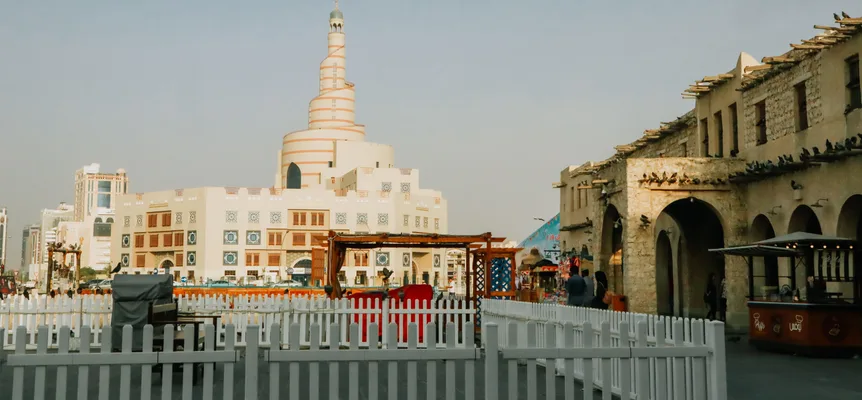
For speaking practice, book a Qatari teacher through tutor platforms where you can filter for Qatari teachers, and say you want the Doha dialect rather than Gulf in general. The spiral minaret in the photo above belongs to the Abdulla Bin Zaid Al Mahmoud Islamic Cultural Center, which charged QR 300 a course in 2025, but its classes teach standard Arabic, not Qatari.
Most Qataris understand Egyptian Arabic, which Qataris hear on television every day, so a Masri speaker gets by in Doha, but the question words and the word for not are different. Further south, Omani Arabic, at the far edge of the Gulf family, keeps older features that most of the Gulf has lost. And if you are still weighing regions, our guide to choosing between Gulf, Egyptian and Levantine Arabic sets out the trade-off. Choose Qatari only if Qatar is where you will be. Our order would be the Asma crash course and a Gulf textbook first, then a Qatari tutor once you can hold a basic conversation.
Frequently asked questions
How do you say hello in Qatari Arabic?
Say hala to anyone you know, or as-salamu alaykum to a stranger, and expect wa alaykum as-salam back. The next question is shlonik to a man or shlonich to a woman, meaning how are you. Ana zein, I am good, is a common answer.
How do you say I love you in Qatari?
Ahibik to a man and ahibich to a woman. The ch at the end is the Gulf ending for a feminine you, the same one that turns shlonik into shlonich. Modern Standard Arabic says uhibbuka and uhibbuki, which Qataris understand but would never say to each other.
Do Qataris speak Arabic?
Yes. Arabic is the official language under Article 1 of Qatar's constitution, and a 2019 law requires government bodies to use it. Qatari citizens speak their own Gulf dialect at home and in the majlis. Most people living in Qatar are foreign workers, so English carries daily business in Doha, but Qatar's statistics office does not publish how many residents are citizens.
What is the hardest dialect of Arabic?
Nobody has measured it, but English speakers who learned Modern Standard Arabic first usually name Moroccan or Algerian, because their vowels and vocabulary sit furthest from the written language. Qatari is at the easier end. It keeps the th sound of the standard language and much of its vocabulary. The hard part is that very little teaching material exists for it.
Can Qataris understand Egyptian Arabic?
Most can, without effort. Egyptian film and television have played on Gulf screens for decades, so Qataris grow up hearing Masri. That does not make Egyptian a shortcut to Qatari. The everyday words for how, want and not are all different: Egyptian izzay, ayiz and mish against Qatari shlon, abi and mub.