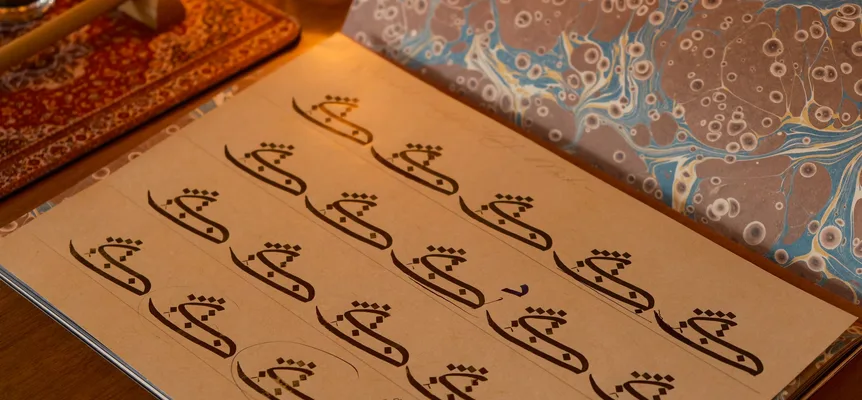
Arabic cursive is simply how Arabic is written: in print and by hand, the letters of a word join into one line, from right to left. Twenty-two of the 28 letters join on both sides. Six, ا د ذ ر ز و, join only to the letter before them, which leaves gaps inside words. There is no separate print alphabet.
The joining lab needs JavaScript. The tables further down the page show the same rules.
Or pick a word:
Joined, the way Arabic is written
Unjoined: every letter in its isolated form
- initial
- medial
- final
- isolated
Trace the word
Trace over the grey letters with a finger or the mouse, starting on the right. The dashed line is the baseline the letters sit on.
Print and handwriting: the same letters in Naskh and Ruqah
| Letter | Print (Naskh) | Handwriting (Ruqah) | What changes in Ruqah |
|---|---|---|---|
| ه hāʾ | ه قهوة | ه قهوة | In the middle of a word, hāʾ is a single small loop that dips below the line. It is one of the few Ruqah letters that goes below the line at all. |
| ي yāʾ | ي بيت | ي بيت | The two dots under yāʾ are written as one short stroke, and so are the two dots over tāʾ. |
| ك kāf | ك كتاب | ك كتاب | Kāf on its own is one closed curl with a slanting stroke on top, without the small mark Naskh draws inside it. |
| س sīn | س سمكة | س سمكة | The three teeth of sīn flatten into one smooth line. |
| ش shīn | ش شمس | ش شمس | The teeth flatten as in sīn, and the three dots become one small peaked stroke, like a caret (^). |
| ر rāʾ | ر قمر | ر قمر | Rāʾ is short and ends in a flat, clipped tail. In Naskh its tail curves down well below the line. |
Naskh is set in Amiri and Ruqah in Aref Ruqaa, two free fonts under the SIL Open Font License. Without them, the cells show a picture of the same two fonts.
Type a word, tap the letter keys or pick an example. The lab shows the word joined and unjoined, and each letter in its initial, medial, final or isolated shape, with the Unicode presentation form a font uses for it. A dashed box marks a letter that never joins forward, and a red bar marks the gap it leaves.
The joining rules come from Unicode's ArabicShaping.txt, the file that tells every phone and computer how each Arabic letter connects. We checked all 42 letters the lab covers against it. The example words are copied, vowel marks and transliterations included, from our guide on how to read Arabic, step by step and our Arabic word games, so some transliterations mark long vowels (kitāb) and some do not (qahwa).
What you need before you start
You need to recognise the 28 letters, a pen, lined paper and about 30 minutes a day. If the letters are still new, learn them from our Arabic alphabet chart with all four letter forms first.
Lined paper matters more than the pen, because Arabic letters sit on a line. A workbook helps too. The site's owner wrote: "In addition, I used a workbook to practice writing the Arabic letters. You can use almost any Arabic alphabet workbook, just find one that suits you the best." Our free printable Arabic letter worksheets give you one tracing page for each letter.
Step 1: Write from right to left
Start every line at the right edge of the page and move your pen to the left. Inside a word, each letter is written to the left of the one before it, and the joining stroke runs leftward into the next letter.
For the first few days, put a small mark at the right margin of each line as a reminder. On the tracing pad, start at the right end of the grey word.
Step 2: Keep the letters on one baseline
Arabic letters sit on one horizontal line, the baseline, and the joining strokes run along it. The dashed line on the tracing pad is that baseline. Write every word on a ruled line, never on blank paper, until your letters stay level without help.
Not every part of a letter stays on the line. Alif, lām and kāf rise well above it, and the tails of rāʾ, wāw and yāʾ at the end of a word dip below it. Trace a few example words and watch which parts cross the dashed line.
Step 3: Join every letter that can join
Inside a word, join each letter to the next without lifting the pen, except after the six letters that never join forward: ا (alif), د (dāl), ذ (dhāl), ر (rāʾ), ز (zāy) and و (wāw). After one of these, lift the pen and start the next letter fresh, in its initial form. Unicode classes these six as right-joining: they connect to the letter before them only.
The table shows each of the six inside a word, and the pieces the word falls into. Type any of these words into the lab to see the gaps marked.
| Letter | Word | Transliteration and meaning | Written as | Pieces |
|---|---|---|---|---|
| ا alif | كِتَاب | kitāb, book | كتا ب | 2 |
| د dāl | وَرْدِيّ | wardī, pink | و ر د ي | 4 |
| ذ dhāl | هذا | hadha, this (masc.) | هذ ا | 2 |
| ر rāʾ | سَيَّارَة | sayyāra, car | سيا ر ة | 3 |
| ز zāy | زوجة | zawja, wife | ز و جة | 3 |
| و wāw | قَهْوَة | qahwa, coffee | قهو ة | 2 |
هذا and زوجة are printed without vowel marks, as on our pages of the most common Arabic words and words for family members in Arabic. In وَرْدِيّ no two letters touch at all.
Three more rules finish the joining. The letters built on alif and wāw behave like them: أ إ آ (alif with hamza or madda), ؤ (wāw with hamza) and ة (tāʾ marbūṭa, which ends many feminine words) join only backward. Hamza on its own, ء, joins neither side. And lām followed by alif is always written as one sign, لا, which on its own is the word lā, "no". Type سلام in the lab and it names the ligature Unicode uses for it.
Step 4: Write the dots last
Write the body of each joined piece first, then go back and add its dots, from right to left. Fifteen of the 28 letters carry dots, and the dots are the only difference between letters like ب (b), ت (t) and ث (th).
Arabic writers normally add the dots at the end. A 2006 study of handwriting recognition by researchers at Columbia University and Ben-Gurion University calls dots and small strokes "delayed strokes" because they are "usually drawn last in a handwritten word-part/word", typically right after the writer finishes that piece. The same study points out that a dot moved or dropped can turn a word into a different word, so count your dots against the model every time.
Step 5: Count the teeth
At the start or in the middle of a word, bāʾ, tāʾ, thāʾ, nūn and yāʾ all shrink to the same short upright stroke, called a tooth, and only the dots tell them apart. Sīn and shīn have three teeth each. Write each tooth to the same height, and make sure every letter gets its own tooth.
Look at بَيْت (bayt, house) in the lab: a tooth with one dot below, a tooth with two dots below, then the final tāʾ with two dots above. A missing tooth is an easy slip to make: بيت written with one tooth too few no longer spells bayt.
Step 6: Copy whole words every day
Practise on whole words, because joining is the skill you are training. Every day, pick five words, trace each one twice on the pad above, then copy it three times on lined paper without looking at the model, and check it against the lab.
Choose words that mix joiners and non-joiners. شَمْس (shams, sun) joins all the way, كِتَاب breaks once and فَرَاشَة (farasha, butterfly) breaks twice. When the examples are easy, write your own name: our list of Arabic girl names with their meanings gives the vowelled spelling to copy, and the lab shows how its letters join. By our estimate, the joining itself takes three or four days at 30 minutes a day, as in our reading guide.
Print and handwriting: Naskh and Ruqah
Print and handwriting are the same joined script in two styles. Books and screens mostly use Naskh. Everyday handwriting is mostly Ruqah, which English Wikipedia calls "the most common type of handwriting in the Arabic script". The table at the bottom of the lab puts six letters in both styles side by side.
Ruqah was developed in the 19th century for fast writing, and Wikipedia credits two Ottoman calligraphers, Mumtaz Efendi and Mustafa Izzet Efendi, with standardising it. The type designer Pascal Zoghbi writes that most Arab children learn to write in Ruqah at school, and that its alif is about three pen-dots tall. The Arabic Wikipedia article on the Ruqah script adds two points. Nearly every Ruqah letter sits on the line, and only a few go below it: hāʾ in the middle of a word, jīm, ḥāʾ, khāʾ, ʿayn and ghayn on their own, and mīm at the end of a word. And the handwriting most people use today is usually a mix of Naskh and Ruqah.
The letter shapes in the lab's table are the two free fonts it uses, Amiri for Naskh and Aref Ruqaa for Ruqah. In them, sīn and shīn lose their teeth, pairs of dots become one short stroke, the three dots of shīn become one peaked stroke and rāʾ ends in a short, flat tail. Learn to write the Naskh shapes first, since your textbook and the worksheets use them, and learn to read Ruqah once you meet handwritten notes. For more styles, see our free Arabic fonts compared side by side or turn your own text into an image with the Arabic calligraphy generator.
Common mistakes
Most writing mistakes come from treating Arabic letters as separate blocks, as in English print.
- Writing every letter on its own. Unjoined letters in their stand-alone shapes are the classic fault in Arabic tattoos and signs made with old software. Our page on why unjoined letters ruin an Arabic tattoo shows what it looks like, and the lab's unjoined line shows the same thing for any word you type.
- Joining a letter that never joins forward. A stroke from alif into the bāʾ of كتاب is a join Arabic does not have. After the six non-joiners, lift the pen.
- Writing lām and alif as two letters. لا is one sign wherever lām is followed by alif.
- Losing count of the teeth or dots. One tooth too few, or a dot on the wrong tooth, changes the word. Check the count against the lab.
- Copying Ruqah before Naskh. Ruqah merges and drops details that you still need in order to recognise letters in print.
What to do next
Once you can write the example words from memory, move on to short sentences. Print the alphabet worksheets for daily tracing; for children, our Ramadan worksheets for children give the same practice on Ramadan words. Practise reading alongside writing with our six steps to reading Arabic, and when you can read and write the letters, our roadmap for learning Arabic shows what to study next.
The same joining rules carry over to Persian, Urdu and the other languages written in Arabic letters, which add letters of their own. Our guide to the Perso-Arabic alphabet and its extra letters covers them, and the lab already knows six of them: type پاکستان to see پ and ک join.
Frequently asked questions
Can Arabic be written in cursive?
Yes, and it always is. Arabic is joined up, in print as well as by hand, and it runs from right to left. Twenty-two of the 28 letters join the letters on both sides of them. Six, ا د ذ ر ز و (alif, dāl, dhāl, rāʾ, zāy and wāw), join only to the letter before them, which is why many words have small gaps.
Is there a print form of Arabic, like print and cursive in English?
No. There is no separate unjoined alphabet: printed Arabic is joined exactly like handwriting, and only the style differs. Books, newspapers and screens mostly use Naskh, and everyday handwriting is mostly Ruqah, which has shorter letters, flatter teeth and dots merged into strokes. Learn the Naskh shapes first, because that is what you will read.
Can you write Arabic without joining the letters?
Not correctly. A word written as separate letters, each in its stand-alone shape, reads like a word spelled out letter by letter, and it is the classic mistake in Arabic tattoos and in old software. The only gaps in a correctly written word come after the six letters that never join forward, after a hamza on the line, and between words.
Which Arabic letters do not connect?
Six letters never connect to the letter after them: ا (alif), د (dāl), ذ (dhāl), ر (rāʾ), ز (zāy) and و (wāw). They still join the letter before them. The forms built on them do the same: أ إ آ (alif with hamza or madda), ؤ (wāw with hamza) and ة (tāʾ marbūṭa). Hamza on its own, ء, joins neither side.
How long does it take to learn to write in Arabic?
By our estimate, about two weeks at 30 minutes a day to know the letters, their sounds and how they join, the same estimate as our guide to reading Arabic. Writing words neatly and at speed takes longer, and it comes from daily practice: trace and copy a few whole words every day rather than drilling single letters.