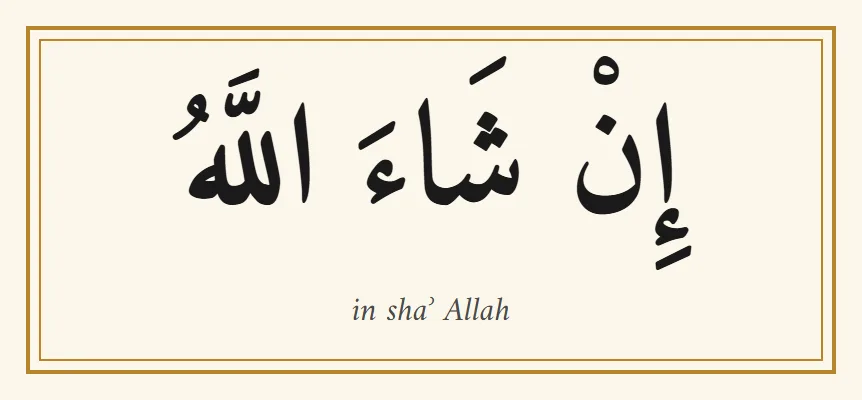
Islamic Phrases in Arabic > Inshallah Meaning
Inshallah (إن شاء الله, in shaʾ Allah) means "if God wills". It is three words: in, if; shaʾa, willed; and Allah, God. It goes with anything that has not happened yet, from a bus time to a wedding, and Muslims and Arab Christians alike say it. The Quran tells believers to add it to their plans.
The image maker runs in your browser and needs JavaScript turned on.
Lettering
Colours
Size
Nothing leaves your browser; the only thing fetched is the three fonts, from Google Fonts. To letter your own text in twelve fonts, use the Arabic calligraphy generator.
Ticking the vowel marks shows the phrase as three words kept apart, the spelling that stops it reading as إنشاء, creation. Then save the PNG.
Inshallah in Arabic letters
Inshallah is written as three words, إن شاء الله, read from right to left. The English one-word spelling is a convenience; in Arabic the words stay apart.
| Arabic | Transliteration | Meaning | Listen |
|---|---|---|---|
| إن شاء الله | in shaʾ Allah | if God wills | |
| إِنْ شَاءَ اللَّهُ | in shāʾa llāhu | the same, every vowel marked | |
| إِنْ | in | if | |
| شَاءَ | shāʾa | he willed, wished (root sh-y-ʾ) | |
| اللَّهُ | Allāhu | God | |
| إنشاء الله | inshāʾ Allāh | wrong: inshāʾ means creation, construction | — |
The verb is in the past tense, so Wiktionary translates the phrase literally as "if God has willed [it]". Arabic uses the past after in, if, for a condition that has not yet been met, which is why the English "if God wills" is the better gloss. Transliteration follows our table of Islamic phrases: ʾ is the glottal stop, the catch in uh-oh.
Where inshallah comes from: the Quran
In shaʾ Allah comes from the Quran, which tells believers to attach it to anything they plan. The instruction is in Surah al-Kahf, 18:23–24:
وَلَا تَقُولَنَّ لِشَا۟ىْءٍ إِنِّى فَاعِلٌ ذَٰلِكَ غَدًا (18:23)
إِلَّآ أَن يَشَآءَ ٱللَّهُ (18:24, opening words)
In meaning: never say of anything "I will do that tomorrow" without adding "if God wills" (Quran 18:23–24). The verse uses a longer form, illa an yashaʾa Allah, "unless God wills". The short formula itself, إِن شَآءَ ٱللَّهُ, appears word for word in six verses. We counted them in two independent Quran texts, the quran.com text and Tanzil's, and both give the same six:
| Verse | Who says it | About what |
|---|---|---|
| 2:70 | the Children of Israel, to Moses | "we will be guided, if God wills", about the cow they are told to sacrifice |
| 12:99 | Joseph, to his parents | "enter Egypt, if God wills, in safety" |
| 18:69 | Moses, to the man he follows | "you will find me, if God wills, patient" |
| 28:27 | the father in Madyan, to Moses | "you will find me, if God wills, among the righteous", agreeing a marriage |
| 37:102 | Abraham's son, to his father | "you will find me, if God wills, among the steadfast" |
| 48:27 | God, to the believers | "you will enter the Sacred Mosque, if God wills, in safety" |
All six are about the future, and four are promises a speaker makes about himself, the use the phrase still has today. The verse quotes above are our short renderings; the Arabic is copied from quran.com.
How to reply to inshallah
Inshallah has no fixed reply, and nothing is required. It is not a prayer, so amin is not called for: SeekersGuidance answers that saying amin after in shaʾ Allah is not necessary, for that reason. What you say depends on what the speaker attached it to.
| You hear | It means | You say back |
|---|---|---|
| بكرة إن شاء الله bukra in shaʾ Allah | tomorrow, God willing | إن شاء الله in shaʾ Allah, to share the hope; or nothing |
| يا رب تكون سنة خير ya rabb tkun sanat khayr | O Lord, may it be a year of goodness | إن شاء الله in shaʾ Allah |
| a slow, drawn-out إن شاء الله in shaʾ Allah, with no time or place | maybe, or a soft no | a kind follow-up question: so it is for sure? |
| a prayer for you: الله يوفقك Allah ywaffqak, may God grant you success | a supplication | آمين amin, amen: the answer to a prayer, not to in shaʾ Allah |
The new-year wish and its in shaʾ Allah answer are from our page on how to say happy new year in Arabic. The drawn-out "maybe" is described by Gulf News (August 2026): a confident inshallah with a time attached is a yes, a long pause and a change of subject usually is not, and a warm follow-up question lets the other person answer plainly. Our Emirati Arabic guide covers the rest of everyday speech in the UAE.
Inshallah across dialects and languages
In shaʾ Allah barely changes between dialects. Our phrasebook of polite everyday Arabic gives the same إن شاء الله for Modern Standard, Levantine and Egyptian Arabic, and the Islamic phrases table files it under "any sentence about the future, from a bus time to a wedding".
Outside Arabic, Wiktionary lists Turkish inşallah, Indonesian insya Allah, French inch'Allah and German Inschallah, among dozens of others. Spanish ojalá, "I hope so", comes from an Arabic phrase built the same way: Wiktionary gives law shāʾa llāh, "if God willed", or wa-shāʾa llāh. In English, Wiktionary also records a sarcastic use, "yeah, right", which it notes is more attested in English than in Arabic. "Inshallah meaning" ties "habibi meaning" as the most searched question in this word family, at 90,500 US searches a month each (Google data fetched 25 September 2026); our Arabic search statistics list the rest.
Common mistakes with inshallah
The worst spelling mistake is إنشاء الله, with the first two words run together. إنشاء inshāʾ is a different word, "establishment, creation" in Wiktionary, so the phrase then reads as "the creation of God". Keep the three words apart: إن شاء الله.
Second, tense. In shaʾ Allah is for what has not happened yet; for something already done, the phrase is mashallah, what God has willed. Third, using it as a brush-off. The National calls it a sincere commitment, not a polite deflection, and advises not saying it at all if you do not mean to try.
Last, the English spellings. Inshallah, insha'Allah and in sha Allah all write the same three Arabic words, and our 29 Islamic phrases with their replies explain why reading the run-together form as one block puts the stress in the wrong place. Our phrasebook gives in shaʾ Allah the same form in Modern Standard, Levantine and Egyptian Arabic; for the everyday phrases that do change, search our Arabic dialect phrasebook.
Frequently asked questions
What does inshallah mean?
Inshallah (إن شاء الله, in shaʾ Allah) means if God wills. It is three words: in, if; shaʾa, willed; and Allah, God. It is attached to anything that has not happened yet, from a bus time to a wedding, and Muslims and Arab Christians alike say it.
How do you reply to inshallah?
Nothing is required. In shaʾ Allah is not a prayer, so amin is not needed after it. If you share the hope, saying in shaʾ Allah back is natural. If you need a firm answer, ask again kindly: Gulf News suggests a warm follow-up such as so it is for sure?
Does inshallah mean no?
Not by meaning. It says if God wills, and it is often a real yes. A slow, drawn-out inshallah with no time or place attached can soften a refusal, which is how Gulf News describes its use in the UAE, but treating every inshallah as a polite no is a mistake and can offend.
How is inshallah written in Arabic?
إن شاء الله, three separate words. With vowel marks it is إِنْ شَاءَ اللَّهُ. Do not write it إنشاء الله: إنشاء is a different word, meaning creation or construction. Inshallah run together is an English spelling only.
What is the difference between inshallah and mashallah?
Tense. In shaʾ Allah, if God wills, is about the future: plans, appointments, promises. Ma shaʾ Allah, what God has willed, is about something that has already happened, such as a new baby or good work. Praising a finished thing with in shaʾ Allah sounds as if you doubt it exists.