Islamic Phrases in Arabic > Alhamdulillah Meaning
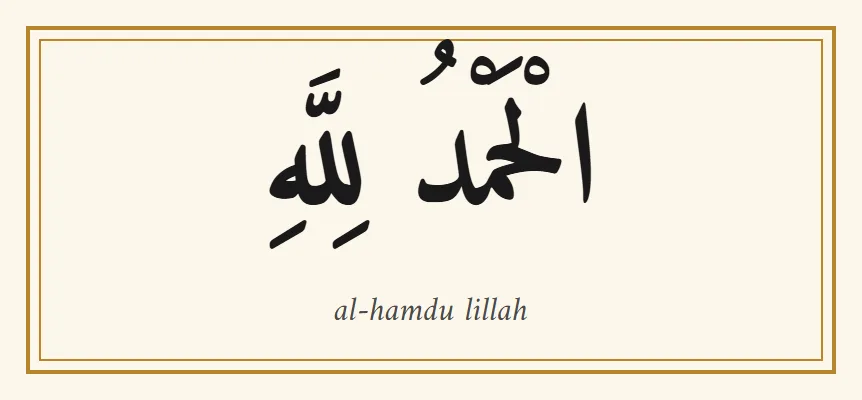
Alhamdulillah (الحمد لله, al-hamdu lillah) means "praise be to God", often said as "thank God". It is al, the; hamd, praise; li, to; and Allah, God. It answers "how are you?" whatever the day was like, closes a meal, greets good news and follows a sneeze. It is the second verse of the Quran.
The image maker runs in your browser and needs JavaScript turned on.
Lettering
Colours
Size
Nothing leaves your browser; the only thing fetched is the three fonts, from Google Fonts. To letter your own text in twelve fonts, use the Arabic calligraphy generator.
With the vowel marks ticked, the sukun over the l of al- shows that the l is pronounced, the moon-letter rule explained below. Then save the PNG.
Alhamdulillah in Arabic letters
Alhamdulillah is two Arabic words, الحمد لله, read from right to left.
| Arabic | Transliteration | Meaning | Listen |
|---|---|---|---|
| الحمد لله | al-hamdu lillah | praise be to God; thank God | |
| الْحَمْدُ لِلَّهِ | al-ḥamdu li-llāhi | the same, every vowel marked | |
| الْ | al- | the | — |
| حَمْد | ḥamd | praise (root ḥ-m-d) | |
| لِلَّهِ | li-llāhi | to God: li, to, joined to Allah | |
| الحمد لله على السلامة | al-hamdu lillah ʿa-s-salama | thank God you are safe (after a trip or an illness) |
The l of al- is pronounced, because ح is a moon letter; our sun and moon letters tool shows the rule. And لله is li, to, joined to الله Allah, which drops its first alif when the two meet.
The root ḥ-m-d: praise, and the names Muhammad and Ahmad
حَمْد ḥamd, praise, comes from the root ḥ-m-d, and so do some of the most common names in the Arab world. Our Arabic name generator gives Muhammad as "praised, praiseworthy" and Ahmad as "more praiseworthy", both from this root, and our 99 names of Allah list al-Hamid, the Praiseworthy, under the same three letters.
| Arabic | Transliteration | Meaning |
|---|---|---|
| حَمْد | ḥamd | praise |
| مُحَمَّد | Muḥammad | praised, praiseworthy (name generator) |
| أَحْمَد | Aḥmad | more praiseworthy, most praiseworthy (name generator) |
| الحميد | al-Ḥamīd | the Praiseworthy, one of the 99 names |
Alhamdulillah in the Quran
Al-hamdu lillah is the second verse of the Quran, right after the basmala in al-Fatiha, 1:2:
ٱلْحَمْدُ لِلَّهِ رَبِّ ٱلْعَـٰلَمِينَ
In meaning: praise be to God, Lord of the worlds (Quran 1:2). The words open four more suras: 6:1, 18:1, 34:1 and 35:1. We counted the phrase in two independent Quran texts, quran.com's and Tanzil's: الحمد لله stands on its own in 21 verses, and as والحمد لله, "and praise be to God", in two more, 6:45 and 37:182. Both texts gave the same 23 verses.
The sneeze exchange comes from a hadith. Sahih al-Bukhari 6224 records the Prophet saying that whoever sneezes should say al-hamdu lillah, the one who hears it should answer يَرْحَمُكَ اللَّهُ, and the sneezer should then say يَهْدِيكُمُ اللَّهُ وَيُصْلِحُ بَالَكُمْ. The Quran text is copied from quran.com and the hadith from the Arabic of Sahih al-Bukhari in sunnah.com's numbering; the renderings are ours.
How to reply to alhamdulillah
Usually you do not reply to al-hamdu lillah: it is praise addressed to God, not to you. The exceptions are a sneeze, which runs a fixed three-step exchange, and the moments where al-hamdu lillah is itself an answer.
| You hear | It means | You say back |
|---|---|---|
| الحمد لله al-hamdu lillah, after a sneeze | praise be to God | يرحمك الله yarhamuka Allah, may God have mercy on you |
| يرحمك الله yarhamuka Allah, after you sneezed | may God have mercy on you | يهديكم الله ويصلح بالكم yahdikumu Allahu wa yuslihu balakum |
| بخير، الحمد لله bi-khayr, al-hamdu lillah, to your how are you | well, praise God | ask it back: وانت؟ w-inta? and you? |
| الحمد لله على السلامة al-hamdu lillah ʿa-s-salama | thank God you are safe | الله يسلمك Allah yisallimak, may God keep you safe |
| الحمد لله al-hamdu lillah, at the end of a meal or after good news | praise be to God | nothing needed; say it too if you share the meal or the news |
The sneeze rows match our table of Islamic phrases and the hadith above; the salama row is from our page of Arabic wishes and congratulations; the how-are-you row is from our everyday phrasebook, which adds that you should then ask the question back.
Alhamdulillah across the dialects
Al-hamdu lillah is the expected answer to "how are you?", "whatever is actually true", as our Saudi Arabic guide puts it. Across the dialects, the word before it is what changes.
| Dialect | Arabic | Transliteration | Meaning |
|---|---|---|---|
| Modern Standard | بخير، الحمد لله | bi-khayr, al-hamdu lillah | well, praise God |
| Levantine | منيح، الحمد لله | mnih, il-hamdulillah (a woman: mniha) | good, praise God |
| Egyptian | كويس، الحمد لله | kwayyis, il-hamdulillah (a woman: kwayyisa) | good, praise God |
| Kuwait | زين، الحمد لله | zain, il-hamdulillah | fine, praise God (our Kuwaiti Arabic page) |
| Saudi Arabia | الحمد لله | al-hamdu lillah | fine, praise God: the expected answer on its own (our Saudi Arabic page) |
| Qatar | أنا زين | ana zein | I'm good; our Qatari Arabic page gives it without al-hamdu lillah |
| Oman | بخير، الحمد لله | bi-kher, al-hamdu lillah | well, praise God |
Outside Arabic, Wiktionary lists Turkish elhamdülillah, Indonesian and Malay alhamdulillah and French hamdoullah, and notes that in Indonesia people of other religions use it colloquially too. Some searchers want the script itself: "alhamdulillah in arabic" draws 6,600 US searches a month, a fifth of the 33,100 for "alhamdulillah meaning" (Google data fetched 5 October 2026). Our Arabic search statistics have the rest.
Common mistakes with alhamdulillah
First, using it as "thank you" to a person. It praises God; to thank the person in front of you, say shukran. Second, leaving a sneeze exchange half done: after yarhamuka Allah, the sneezer still owes the closing line.
Third, spelling. Wiktionary marks alhamdullilah, with the doubled l in the wrong word, as a misspelling; the doubled l belongs in lillah. In Arabic the phrase is two words, الحمد لله, and our 29 Islamic phrases with their replies explain why the run-together English form puts the stress in the wrong place.
A meal opens with bismillah, in the name of God, said before the first bite, and closes with al-hamdu lillah, said after it. The word before al-hamdu lillah changes by dialect (mnih, kwayyis, zain), and our Arabic dialect phrasebook has the other everyday answers, searchable by dialect.
Frequently asked questions
What does alhamdulillah mean?
Alhamdulillah (الحمد لله, al-hamdu lillah) means praise be to God, and in everyday speech often thank God. It is al, the; hamd, praise; li, to or for; and Allah, God. It answers how are you, closes a meal, greets good news and follows a sneeze, and it is the second verse of the Quran.
What do you say when someone says alhamdulillah after sneezing?
Yarhamuka Allah, may God have mercy on you. The sneezer then answers yahdikumu Allahu wa yuslihu balakum, may God guide you and set your affairs right, which closes the exchange. Sahih al-Bukhari 6224 records all three steps.
How do you reply to alhamdulillah?
Usually nothing, because it is praise addressed to God. When it answers your how are you, ask the question back. When someone says al-hamdu lillah ʿa-s-salama, thank God you are safe, after a trip or an illness, answer Allah yisallimak. After a sneeze, answer yarhamuka Allah.
Is alhamdulillah the same as thank you?
No. Alhamdulillah thanks and praises God; to thank a person, say shukran. The English gloss thank God is close, which is why alhamdulillah follows good news, but saying it to someone who holds a door for you would miss the person you mean to thank.
How do you spell alhamdulillah?
In Arabic, الحمد لله, two words. In English the common spelling is alhamdulillah, or al-hamdu lillah when the words are kept apart. Wiktionary lists alhamdullilah, with the double l in the wrong place, as a misspelling.