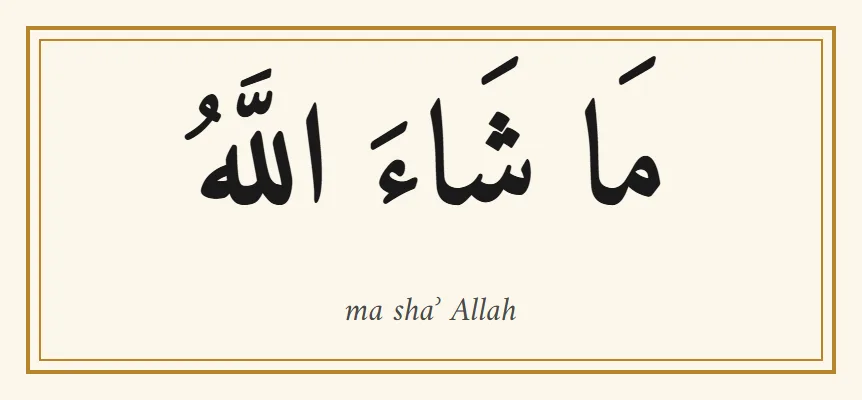
Islamic Phrases in Arabic > Mashallah Meaning
Mashallah (ما شاء الله, ma shaʾ Allah) means "what God has willed". You say it on seeing something good that already exists: a new baby, a finished house, a piece of good work. It praises the thing and credits God for it, and Wiktionary records its use against the evil eye. Its model is Quran 18:39.
The image maker runs in your browser and needs JavaScript turned on.
Lettering
Colours
Size
Nothing leaves your browser; the only thing fetched is the three fonts, from Google Fonts. To letter your own text in twelve fonts, use the Arabic calligraphy generator.
The image keeps ما شاء الله as three words, the way Arabic writes it; tick the vowel marks to show mā shāʾa llāhu in full, then save the PNG.
Mashallah in Arabic letters
Mashallah is three Arabic words, ما شاء الله, read from right to left. The one-word English spelling hides that.
| Arabic | Transliteration | Meaning | Listen |
|---|---|---|---|
| ما شاء الله | ma shaʾ Allah | what God has willed | |
| مَا شَاءَ اللَّهُ | mā shāʾa llāhu | the same, every vowel marked | |
| مَا | mā | what | |
| شَاءَ | shāʾa | (he) willed (root sh-y-ʾ) | |
| ما شاء الله لا قوة إلا بالله | ma shaʾ Allah, la quwwata illa billah | what God has willed; there is no power except in God (18:39) | |
| ما شاء الله تبارك الله | ma shaʾ Allah, tabarak Allah | what God has willed; blessed is God |
Mashallah shares two of its three words with inshallah, if God wills. Only the first word changes: mā, what, looks back at something done, while in, if, looks forward. Wiktionary gives the literal sense of ما شاء الله as "God willed it".
Where mashallah comes from: Quran 18:39
Mashallah comes from Surah al-Kahf. A man with two rich gardens boasts that they will never perish, and his companion rebukes him, 18:39:
وَلَوْلَآ إِذْ دَخَلْتَ جَنَّتَكَ قُلْتَ مَا شَآءَ ٱللَّهُ لَا قُوَّةَ إِلَّا بِٱللَّهِ
In meaning: why, when you entered your garden, did you not say "what God has willed; there is no power except in God"? (Quran 18:39). Said this way, admiration credits God instead of the owner. The Arabic is copied from quran.com; the rendering is ours. To read verses like this one unaided, see our guide to learning Quranic Arabic.
The words ما شاء الله occur in five verses. We counted them in two independent Quran texts, quran.com's and Tanzil's, with the same result. In four of the five (6:128, 7:188, 10:49, 87:7) they are part of illa ma shaʾ Allah, "except what God wills". Only 18:39 uses them as the exclamation people say today.
The evil-eye side of the phrase rests on a separate hadith. Sahih al-Bukhari 5740 records the Prophet saying الْعَيْنُ حَقٌّ, "the evil eye is real". The hadith does not mention ma shaʾ Allah; the link is in usage, which The National describes as praise and a form of protection against envy. Wiktionary records that sense too: a wish for a fortune to be kept safe, "especially against the evil eye".
What to say back when someone says mashallah
Mashallah has no fixed reply; our Islamic phrases table lists none, and a Mufti Online answer says it knows of no prescribed response. In practice people return the blessing or simply say thank you.
| You hear | It means | You say back |
|---|---|---|
| ما شاء الله ma shaʾ Allah, about your child | what God has willed: praise, with a guard against envy | بارك الله فيك barak Allahu fik, may God bless you (to a woman: fiki) |
| مبروك البيت الجديد، ما شاء الله mabruk al-bayt al-jadid, ma shaʾ Allah | congratulations on the new house | الله يبارك فيك Allah yibarik fik, God bless you |
| ما شاء الله ma shaʾ Allah, about your work | well done, God be praised | شكرا shukran, thank you; or barak Allahu fik |
| بارك الله فيك barak Allahu fik, your answer, said back to you | may God bless you | وفيك بركة wa fik barakah, and blessing on you |
Barak Allahu fik and its answer are from our Islamic phrases table; mabruk and Allah yibarik fik are from our page of Arabic congratulations, which adds "ma shaʾ Allah when you see it" to the new-house wish.
Mashallah across dialects and languages
Ma shaʾ Allah is the same in every Arabic dialect; it is a fixed formula, and our Islamic phrases table notes that these phrases "barely move by dialect". It has also spread to languages spoken by Muslims, and some beyond.
| Language | Spelling |
|---|---|
| Turkish | maşallah |
| Indonesian and Malay | masya Allah |
| Persian | ماشاءالله (one word) |
| Serbo-Croatian | mašallah, mašala |
| Urdu | ماشاءاَللہ |
Wiktionary's English entry also records a third sense, plain surprise: "Wow!". US searches for "mashallah meaning", 60,500 a month in Google's data fetched on 5 October 2026, run at two thirds of those for "inshallah meaning" (90,500); the Arabic search statistics set it beside the rest.
Common mistakes with mashallah
The first mistake is tense. Ma shaʾ Allah is for what has already happened; for a plan, the phrase is in shaʾ Allah. Praising a finished thing with in shaʾ Allah sounds as if you doubt it exists, and our inshallah page covers the other side.
Second, saying it about yourself. The National reserves mashallah for other people's achievements, so using it to show off your own new car turns around its use in 18:39, where it is a check on boasting.
Third, writing it as one Arabic word, ماشاءالله or ماشالله. The first is how Persian writes it; in Arabic the three words stay apart. Fourth, mixing it up with subhan Allah, glory be to God, which our 29 Islamic phrases with their replies list for astonishment or shock rather than praise. Ma shaʾ Allah needs no dialect version, but the congratulations around it do, as mabruk al-bayt al-jadid shows; our Arabic dialect phrasebook collects phrases like these.
Frequently asked questions
What does mashallah mean?
Mashallah (ما شاء الله, ma shaʾ Allah) means what God has willed. It is said on seeing something good that already exists, such as a new baby, a new house or good work, and it praises the thing while crediting God for it. Wiktionary records its use against the evil eye.
What do you say back when someone says mashallah?
There is no fixed reply. The usual answer is to return the blessing: barak Allahu fik, may God bless you, or in everyday Levantine and Egyptian Arabic Allah yibarik fik. A plain thank you, shukran, also works. Barak Allahu fik in turn is answered wa fik barakah.
What is the difference between mashallah and inshallah?
Tense. Ma shaʾ Allah, what God has willed, is for something that has already happened. In shaʾ Allah, if God wills, is for something that has not happened yet. You say mashallah about a finished house and inshallah about a house you plan to build.
Is mashallah in the Quran?
Yes. The exclamation is in Surah al-Kahf, 18:39, where a man tells his boastful companion he should have said ma shaʾ Allah, la quwwata illa billah on entering his garden. The words ma shaʾ Allah appear in four more verses, always inside illa ma shaʾ Allah, except what God wills.
What does mashallah tabarakallah mean?
What God has willed; blessed is God. Tabaraka Allah, blessed is God, is a Quranic phrase too, in 7:54, 23:14 and 40:64, and many speakers add it to mashallah as a fuller form of the same praise.