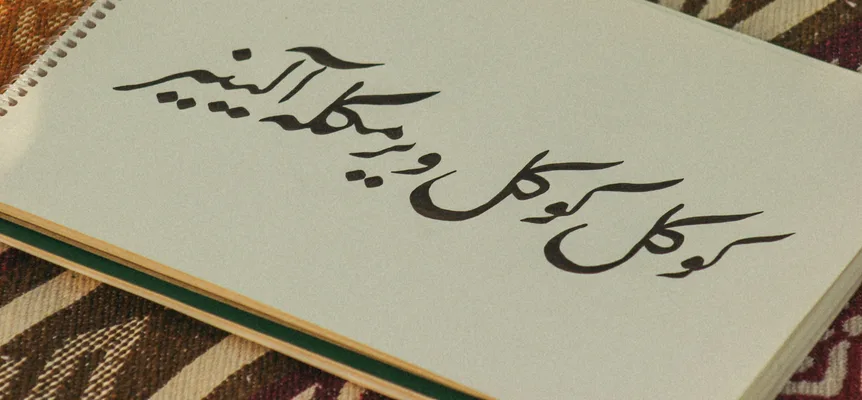
No, Persian (Farsi) is not Arabic. Persian is Indo-European, a distant relative of English; Arabic is Semitic. They share a script and about 8,000 Arabic loanwords. Persian is faster for an English speaker: the US Foreign Service Institute budgets 44 weeks for it and 88 for Arabic. Arabic wins if you want the Quran or the Arab world.
| Point | Arabic | Persian (Farsi) |
|---|---|---|
| Language family | Afro-Asiatic, Semitic | Indo-European, Iranian |
| Speakers | 411 million native, plus 70 million second-language | 91 million native, 127 million in total |
| Official in | 24 states and territories | Iran; Afghanistan (as Dari); Tajikistan (as Tajik, in Cyrillic) |
| Alphabet | 28 letters | 32 letters: the Arabic 28 plus پ چ ژ گ |
| Sounds English lacks | Several: ʿayn, ḥāʾ, the emphatic ṣ ḍ ṭ ẓ, q | Few: kh and gh, both of which Arabic also has |
| Grammatical gender | Yes: verbs, adjectives and "you" change for men and women | None: او (u) means both he and she |
| Word order | Verb first or subject first | Verb last (subject, object, verb) |
| How words are built | Three-letter roots poured into fixed patterns | Stems plus prefixes and endings, like most European languages |
| FSI training time | Category IV: 88 weeks, 2,200 class hours | Category III: 44 weeks, 1,012 class hours |
Sources: speaker figures from Wikipedia's Arabic and Persian language entries (2020 to 2024 estimates); training times from the Foreign Service Institute's language categories. Arabic is transliterated with ʿ for ع, dots under emphatic letters and ā ī ū; Persian as said in Tehran, with â for the long a.
Is Farsi Arabic? No, and the family tree shows why
Farsi is not Arabic. It is the Persian word for Persian, a language on the Indo-European > Iranian branch, in the same family as English and Hindi. Arabic is Semitic, next to Hebrew. After the Islamic conquest of Iran, Persian took Arabic letters and thousands of Arabic nouns, and kept its own grammar.
Even the name shows the contact. The older form was pârsi; Arabic has no p, and Wiktionary traces فارسی (fârsi) to that word reshaped by Arabic fārisī. Poetry is similar: Persian poets name their meters with the Arabic terms of ʿarūḍ, covered in our guide to Arabic poetry and its meters, but the Encyclopaedia Iranica argues the meters themselves differ in origin and structure.
The script: 4 extra letters, and many Arabic letters said alike
Persian uses the Arabic alphabet plus four letters for sounds Arabic lacks, 32 letters in all. An Arabic reader needs only these four to sound out Persian. The other direction is harder, because Persian merges sounds that Arabic keeps apart.
| Letter | Name | Sound | Example |
|---|---|---|---|
| پ | pe | p, as in "pen" | پدر pedar, father |
| چ | che | ch, as in "chair" | چای chây, tea |
| ژ | zhe | zh, the s in "measure" | ژاپن Zhâpon, Japan |
| گ | gâf | g, as in "go" | گل gol, flower |
Persian keeps the Arabic spelling of borrowed words but not the sound. Three letters come out as s, four as z, and most of the throat sounds disappear.
| Persian says | For these Arabic letters | What Arabic keeps apart |
|---|---|---|
| s | ث س ص | th as in "think", plain s, emphatic ṣ |
| z | ذ ز ض ظ | th as in "this", plain z, emphatic ḍ, emphatic ẓ |
| t | ت ط | plain t, emphatic ṭ |
| h | ح ه | the throaty ḥ, plain h |
| a catch in the voice, or nothing | ع ء | ʿayn, hamza |
| one gh-like sound (Tehran) | ق غ | q from the back of the throat, gh |
Values are from Wikipedia's Persian alphabet and Persian phonology entries. So a Persian speaker learning Arabic must relearn sounds for letters they already read. Persian also writes ی and ک where Arabic has ي and ك, and shapes the digits 4, 5 and 6 differently. Our full chart of the Arabic letters shows the 28 shared letters in every position.
20 Arabic words in Persian, and the ones that changed meaning
Arabic gave Persian about 8,000 words in current use, around 40 percent of an everyday literary vocabulary, according to the Encyclopaedia Iranica. The ones that changed meaning are the ones that trip learners up. Each word links to its Wiktionary entry.
| Persian | Arabic source | Meaning in Arabic | Meaning in Persian | Change |
|---|---|---|---|---|
| ملت mellat | مِلَّة milla | religious community, creed | nation, people | Shifted |
| کثیف kasif | كَثِيف kathīf | dense, thick | dirty | Shifted |
| صحبت sohbat | صُحْبَة ṣuḥba | companionship | talk, conversation | Shifted |
| اتفاق ettefâq | اِتِّفَاق ittifāq | agreement, alliance | event, incident (also agreement) | Shifted |
| مزخرف mozakhraf | مُزَخْرَف muzakhraf | decorated, ornamented | nonsense, absurd | Shifted |
| اسباب asbâb | أَسْبَاب asbāb | causes, reasons | luggage (also causes) | Shifted |
| تماشا tamâshâ | تَمَاشٍ tamāshin | walking together | watching, a show | Shifted |
| تعطیل ta'til | تَعْطِيل taʿṭīl | disruption, suspension | holiday, closed | Shifted |
| حیف heyf | حَيْف ḥayf | injustice, oppression | pity, shame ("what a pity") | Shifted |
| حرف harf | حَرْف ḥarf | letter of the alphabet | letter; also speech, talk | Widened |
| دولت dowlat | دَوْلَة dawla | state | state, government; in older writing, fortune | Widened |
| سلام salâm | سَلَام salām | peace | hello, hi | Same greeting |
| کتاب ketâb | كِتَاب kitāb | book | book | Same |
| وقت vaqt | وَقْت waqt | time | time | Same |
| ساعت sâ'at | سَاعَة sāʿa | hour | hour; clock, watch | Same |
| مدرسه madrese | مَدْرَسَة madrasa | school | school | Same |
| خبر khabar | خَبَر khabar | news | news | Same |
| جواب javâb | جَوَاب jawāb | answer | answer, reply | Same |
| عشق eshq | عِشْق ʿishq | passionate love | love, passion; the beloved | Same |
| دنیا donyâ | دُنْيَا dunyā | world | world | Same |
Note the spelling: Arabic ة becomes ت or ه, so milla is ملت and madrasa is مدرسه. Persian sometimes keeps the Arabic plural too: Wiktionary lists both کتب (kotob) and کتابها (ketâb-hâ) for "books". Borrowing also ran the other way, as our guide to Iraqi Arabic and its Persian loanwords shows.
Grammar is where the two languages part completely
Apart from a few borrowed plurals, Persian grammar owes nothing to Arabic. Arabic words arrive as nouns, and Persian builds its own verbs around them: "to talk" is صحبت کردن (sohbat kardan), the Arabic noun plus Persian kardan, "to do", a pattern the Iranica entry describes.
Gender is the biggest single gap. Arabic has هُوَ (huwa, he) and هِيَ (hiya, she), and the verb changes to match; our Arabic pronouns for men, women and pairs shows how many forms that adds up to. Persian has no grammatical gender at all: او (u) means he or she. Persian also puts the verb at the end of the sentence, where Arabic usually puts it first or second. And where Arabic builds verbs by pouring three-letter roots into ten patterns, Persian uses a past stem, a present stem and personal endings, much as Spanish does.
Which is easier for an English speaker?
Persian is easier for an English speaker, taking about half the training time of Arabic. The Foreign Service Institute puts Farsi in Category III, "hard languages", at about 44 weeks (1,012 class hours), and Arabic in Category IV, "super-hard languages", at 88 weeks (2,200 hours), with Chinese, Japanese and Korean. Most of the gap is grammar: a Persian verb has no gender to agree with, and it conjugates the way a Spanish or French verb does. We rate the Arabic side skill by skill in how hard Arabic is to learn.
Who should learn which
Learn Arabic if your reason is the Quran or the Arab world. Learn Persian if your reason is Iran or Afghanistan, or if you want to hold a conversation sooner.
- Pick Arabic for the Quran, for work or family anywhere from Morocco to Iraq, or for reach: it has over four times as many native speakers. Start with the best ways to learn Arabic.
- Pick Persian for Iranian or Afghan heritage, or to read Rumi and Hafez in the original. You will get there in about half the classroom time.
- Learning both? Start with Arabic. Its script and thousands of its words carry straight into Persian. Going the other way, you would have to unlearn the Persian sounds attached to the Arabic letters.
We learned Arabic, not Persian, so the Persian half of this page rests on the linked sources, not our own study. For Arabic's other neighbours, see Arabic vs Hebrew, two Semitic cousins and Arabic vs Urdu, which shares Persian's extra letters.
Are Persians Arabs?
No. Persians are an Iranian people who speak an Indo-European language. The CIA World Factbook's 2025 edition (archived; the CIA stopped publishing it in February 2026) lists Iran's ethnic groups as Persian, Azeri, Kurd, Lur, Baloch, Arab, Turkmen and Turkic tribes, with Persian the official language. The confusion usually comes from religion. The same source gives Iran as 98.5% Muslim, and Muslim prayer is said in Arabic, but the language of daily life is Persian.
Frequently asked questions
Is Farsi Arabic?
No. Farsi is the Persian name for the Persian language, which is Indo-European and belongs to the Iranian branch. Arabic is a Semitic language. Persian is written in a modified Arabic alphabet and has borrowed about 8,000 Arabic words, but its grammar, pronouns and basic vocabulary are its own.
Are Persians considered Arab?
No. Persians are an Iranian people who speak an Indo-European language. The CIA World Factbook's 2025 edition lists Persian and Arab as separate ethnic groups within Iran, and gives Persian as the official language, with Arabic one of several others spoken there.
Can Arabic people understand Persian?
Not without studying it. An Arabic speaker can sound out most Persian writing and will recognise many borrowed nouns, such as ketab (book) and khabar (news). The grammar, the pronouns, the verb endings and everyday words like pedar (father) are unrelated to Arabic, so whole sentences stay out of reach.
How do you say "hi" in Persia?
Salam, written سلام. Persian borrowed it from Arabic salam, which means peace, and uses it as the everyday hello and as the greeting when answering the phone. An Arabic speaker will recognise it at once, even though most of the sentence that follows will be unfamiliar.
Are Persians Muslims or not?
Most people in Iran are. The CIA World Factbook's 2025 edition gives Iran as 98.5% Muslim, with Islam the official religion, plus small Christian, Baha'i, Zoroastrian and Jewish communities (2020 estimate). Religion is not language, though: sharing Islam with Arabs did not make Persian a form of Arabic.