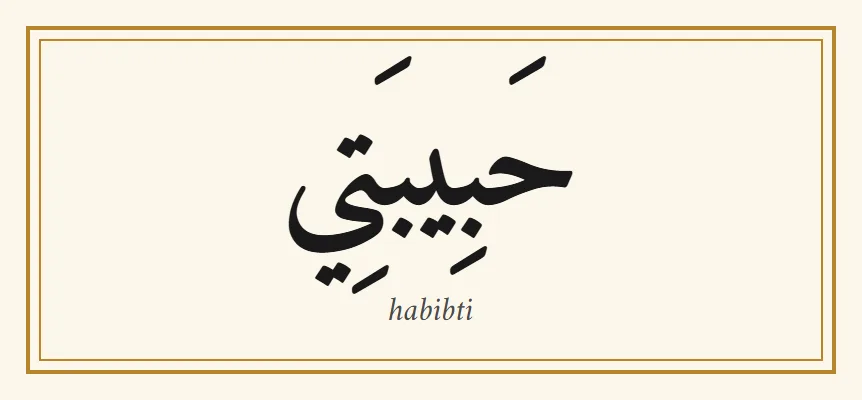
Arabic Slang > Habibti Meaning
Habibti (حبيبتي) means "my darling" or "my beloved", said to a woman or a girl. It is the feminine partner of habibi: حبيبة ḥabība, beloved, plus -ī, my. Mothers say it to daughters, women to their friends, partners to each other. The t comes from the feminine ending, which reappears once "my" is added.
The image maker runs in your browser and needs JavaScript turned on.
Lettering
Colours
Size
Nothing leaves your browser; the only thing fetched is the three fonts, from Google Fonts. To letter your own text in twelve fonts, use the Arabic calligraphy generator.
With the vowel marks ticked, the image spells the Modern Standard ḥabībatī, the four-syllable form explained below; untick them for the everyday habibti, then save the PNG.
Habibti in Arabic letters
Habibti is written حبيبتي: six letters, right to left, all joined. Copy the form you need. The listen buttons use your device's Arabic voice and appear only where the browser has one.
| Arabic | Transliteration | Meaning | Listen |
|---|---|---|---|
| حبيبتي | habibti | my darling, my dear (to a woman or a girl) | |
| حَبِيبَتِي | ḥabībatī | the same in Modern Standard Arabic, every vowel marked | |
| يا حبيبتي | ya habibti | O my dear: the form used to call her | |
| حبيبة قلبي | habibit albi | beloved of my heart | |
| حبيبي | habibi | the masculine, to a man or a boy |
The transliteration is the plain spelling of our Arabic slang page. In the second row, ḥ is the breathy h of ح and the lines mark long vowels.
Why habibti has a t
Habibti has a t because of the feminine ending. "Beloved" is حَبِيب ḥabīb for a man and حَبِيبَة ḥabība for a woman, and the woman's form ends in ة, tāʾ marbūṭa, a letter said as a short a at the end of a word. Attach anything to it and it turns into a full ت, t.
| Step | Arabic | Transliteration | What happens |
|---|---|---|---|
| 1. beloved (a man) | حَبِيب | ḥabīb | root ḥ-b-b, love |
| 2. beloved (a woman) | حَبِيبَة | ḥabība | feminine ending ة, said -a |
| 3. add -ī, my | حَبِيبَتِي | ḥabībatī | ة becomes ت, t |
| 4. everyday speech | حبيبتي | habibti | the short a after b drops out |
The rule is the one our page on Arabic family words shows with خالة khāla, maternal aunt, which becomes خالتي khālatī, my aunt. Every Arabic word ending in ة behaves the same way, so the same step explains khālatī and every word built like it. Wiktionary gives the full form حَبِيبَتِي as ḥabībatī, /ħa.biː.ba.tiː/, four syllables; spoken Arabic drops the a and says habibti in three.
How to reply to habibti
Like habibi, habibti has no reply of its own: you answer the sentence it came with. The one thing to watch is that replies change with the speaker, so a woman answering "how are you" uses the feminine form of "good".
| You hear | It means | You say back |
|---|---|---|
| شكرا حبيبتي shukran habibti | thanks, dear | عفوا ʿafwan, you're welcome; Levantine تكرمي tikrami, to a woman |
| كيفك حبيبتي kifik habibti (Levantine) | how are you, dear? | منيحة، الحمد لله mniha, il-hamdulillah, good, praise God (a woman speaking) |
| إزيك يا حبيبتي izzayyik ya habibti (Egyptian) | how are you, my dear? | كويسة، الحمد لله kwayyisa, il-hamdulillah (a woman speaking) |
| كل سنة وانتي طيبة يا حبيبتي kull sana w-inti tayyiba ya habibti | happy birthday, my dear | وانت طيب w-inta tayyib to a man, وانتي طيبة w-inti tayyiba to a woman: the second half of the wish, said back |
| حبيبتي habibti, from a partner | darling | يا حياتي ya hayati, O my life, or يا عمري ya ʿumri |
Every reply is taken from our own phrasebooks: the thanks and how-are-you rows from polite everyday phrases in three dialects, the birthday wish from how to say happy birthday in Arabic, and the endearments from our I love you guide, which calls hayati and ʿumri stronger than habibti.
Habibti across the dialects
Habibti is understood in every Arabic-speaking country, and our slang table rates it casual: right for family, friends and partners, wrong for a stranger. The dialects vary the words around it more than the word itself.
| Where | Arabic | Transliteration | Meaning and note |
|---|---|---|---|
| Levant | حبيبة | ḥabībe | beloved (a woman): the Levantine ending is -e (Wiktionary, South Levantine) |
| Morocco | حبيبة ديالي | hbiba dyali | my own beloved, for a partner (our I love you guide) |
| Gulf | أحبچ | ahibbich | I love you, to a woman: the Gulf feminine ending -ich (our I love you guide) |
| Everywhere | عزيزتي | ʿazizti | my dear, to a woman: a milder word for friends and family (our I love you guide) |
Search interest follows the masculine: "habibti meaning" draws 18,100 US searches a month, about a fifth of the 90,500 for "habibi meaning" (Google data fetched 25 and 26 September 2026). The full family is in our Arabic search statistics.
Common mistakes with habibti
The first mistake is the opposite of habibi's: calling a man habibti. The ending follows the person addressed, so a man or a boy is always habibi; see our page on what habibi means and how to answer it.
Second, the spoken and written forms differ. Typed or printed, the word is always حبيبتي with its ت; never write حبيبةي, which keeps the ة in the middle of a word, where it cannot stand. Before the word goes on skin or jewellery, paste it into our Arabic tattoo checker.
Third, register. Habibti from a man to a woman he hardly knows sounds too familiar, and The National advises against habibi and habibti with a manager or a professional contact. Between women friends it carries no weight at all.
For the rest of the everyday vocabulary, see the 42 Arabic slang words and the dialects that use them. The feminine endings move with the dialect, kifik in Beirut and izzayyik in Cairo, and our Arabic dialect phrasebook lists more phrases like them by dialect.
Frequently asked questions
What does habibti mean?
Habibti (حبيبتي) means my darling or my beloved, said to a woman or a girl. It is ḥabība, the feminine of ḥabīb, beloved, with the ending -ī, my. Mothers say it to daughters, women say it to friends, and partners say it to each other, so it ranges from dear to darling.
Why is it habibti and not habibi for a woman?
Because Arabic marks the gender of the person you speak to. Beloved is ḥabīb for a man and ḥabība for a woman. Ḥabība ends in ة (tāʾ marbūṭa), which turns into a full ت once an ending is added, so my beloved becomes ḥabībatī, said habibti in everyday speech.
How do you pronounce habibti?
In everyday speech, ha-BIB-ti, three syllables. In Modern Standard Arabic the full form is ḥabībatī, ha-bee-ba-tee, with four syllables; the spoken dialects drop the short a. The first h is ḥ, a breathy h made low in the throat.
Can a man call a woman habibti?
Yes, within the family and between partners, where it is normal. To a woman he hardly knows it can sound too familiar, and it is out of place at work. Between women friends habibti is ordinary and carries no romance at all.
How do you reply to habibti?
Answer the sentence it came with. To shukran habibti (thanks, dear), say ʿafwan. To kifik habibti (Levantine for how are you), a woman answers mniha, il-hamdulillah. To a partner, ya hayati (O my life) or ya ʿumri (O my lifetime) is a warm reply.