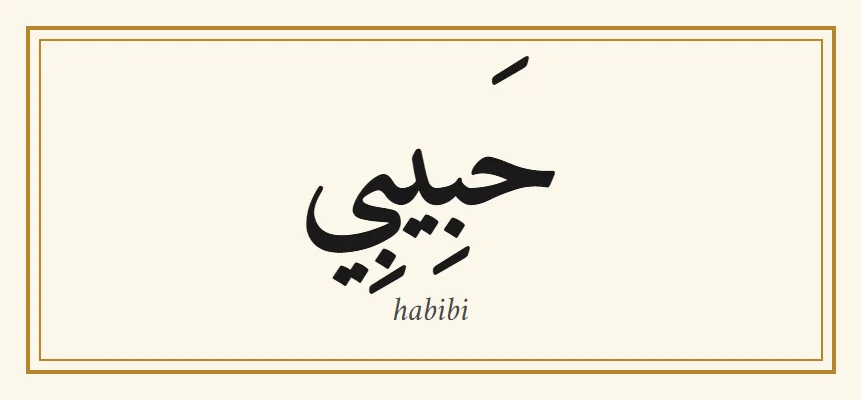
Arabic Slang > Habibi Meaning
Habibi (حبيبي) means "my beloved" or "my darling". It is حبيب ḥabīb, beloved, plus the ending -ī, my. Between friends it works like "mate" or "dear": men say it to other men all the time, parents say it to children, and couples use it too. To a woman the form is habibti.
The image maker runs in your browser and needs JavaScript turned on.
Lettering
Colours
Size
Nothing leaves your browser; the only thing fetched is the three fonts, from Google Fonts. To letter your own text in twelve fonts, use the Arabic calligraphy generator.
Tick the vowel marks to add the fatha over ح and a kasra under each ب, the marks that spell out ḥabībī, then save the PNG.
Habibi in Arabic letters
Habibi is written حبيبي, five letters read from right to left, and all five join. Copy the form you need from the table. The listen buttons use your device's Arabic voice, so they appear only where the browser has one.
| Arabic | Transliteration | Meaning | Listen |
|---|---|---|---|
| حبيبي | habibi | my beloved, my dear (to a man or a boy) | |
| حَبِيبِي | ḥabībī | the same, with every vowel marked | |
| يا حبيبي | ya habibi | O my dear: the form used to call someone | |
| حبيبتي | habibti | my beloved, my dear (to a woman or a girl) | |
| حبايبي | habaybi | my dear ones (Levantine plural) |
Transliteration on this page is the plain spelling our Arabic slang page uses; the second row gives the scholarly form, where ḥ is the breathy h of ح and the lines mark long vowels. In chat, Arabic speakers type habibi as 7abibi, with the digit 7 standing in for ح.
What habibi means, word by word
Habibi is two pieces: the word حَبِيب ḥabīb, "beloved, sweetheart, dear, darling" in Wiktionary's entry, and the suffix ـي -ī, "my". Ḥabīb comes from the root ḥ-b-b, the root of love, which also gives حُبّ ḥubb, love, and بحبك bahebbak, I love you, in Egyptian Arabic.
| Part | Arabic | Meaning |
|---|---|---|
| ḥabīb | حَبِيب | beloved, dear (root ḥ-b-b, love) |
| -ī | ـِي | my |
| ḥabībī, literally | حَبِيبِي | my beloved |
| habibi, in use | حبيبي | mate, dear, buddy (friends); sweetheart (children); darling (partners) |
The literal meaning is romantic. The everyday meaning mostly is not. Our guide to saying I love you in Arabic sets habibi among more than twenty terms of endearment: friends call each other habibi all the time, while ya hayati (O my life) and ya ʿumri (O my lifetime) are kept for people you are close to.
How to reply to habibi
Habibi has no reply of its own. It rides on another sentence, so you answer that sentence, and you can add habibi back to a man or habibti to a woman. These are the situations where you will hear it most, with an answer that fits each one.
| You hear | It means | You say back |
|---|---|---|
| شكرا حبيبي shukran habibi | thanks, mate | عفوا ʿafwan, you're welcome (everywhere); Levantine تكرم tikram |
| كيفك حبيبي kifak habibi (Levantine) | how are you, dear? | منيح، الحمد لله mnih, il-hamdulillah, good, praise God |
| إزيك يا حبيبي izzayyak ya habibi (Egyptian) | how are you, my dear? | كويس، الحمد لله kwayyis, il-hamdulillah, good, praise God |
| يلا حبيبي yalla habibi | come on, mate; let's go | أكيد، جاي akid, jay, sure, I'm coming |
| حبيبي habibi, from a partner | darling | يا حياتي ya hayati, O my life, or يا عمري ya ʿumri, O my lifetime |
The answers come from our own phrasebooks: the thank-you and how-are-you replies from polite everyday phrases in three dialects, akid, jay from the slang table, and the endearments from the I love you guide. Answering a partner's habibi with ya hayati says more than habibi does.
Habibi in the dialects, and outside Arabic
Habibi is one of the few slang words heard in every Arabic-speaking country. Our slang table tags it "everywhere" and "casual": safe with friends and family, too familiar for someone you have just met. What changes from place to place is the company it keeps.
| Where | Arabic | Transliteration | Meaning and note |
|---|---|---|---|
| Everywhere | حبيب قلبي | habib albi | beloved of my heart; for a partner or family (our I love you guide) |
| Levant | حبايب | habayeb | dear ones, the plural, so habaybi is "my dear ones" (Wiktionary, South Levantine) |
| Egypt | حبيبي يا نور العين | habibi ya nur il-ʿein | my love, light of my eye: the first line of Amr Diab's 1996 song, on our list of Arabic songs to learn from |
| Morocco | حبيبي ديالي | hbibi dyali | my own beloved, for a partner (our I love you guide). Moroccan ḥbib can also mean maternal uncle (Wiktionary) |
The word has travelled. Modern Hebrew borrowed habibi as everyday slang for darling, as our Arabic and Hebrew comparison notes, and Wiktionary records it as slang in Swedish, where it also means friend, and in Arab Australian English. More Americans search for the bare word "habibi", about 110,000 a month in Google's data fetched on 5 October 2026, than for "habibi meaning" (90,500, fetched 25 September); our study of how the world searches for Arabic sets both beside the rest of this word family.
Common mistakes with habibi
The most common mistake is using habibi for a woman. Arabic marks the gender of the person you address, so a woman or a girl is habibti (حبيبتي), and our page on what habibti means and why it has a t takes that form apart.
Second, habibi is casual. The National's April 2026 guide to commonly misused Arabic words warns against calling a manager or a professional contact habibi before you know the relationship, and a man saying habibti to a woman he hardly knows can sound too familiar.
Third, reading habibi as "my love" every time. Between friends it means no more than "mate", so a shopkeeper's itfaddal ya habibi, go ahead, my dear, is courtesy.
For the rest of the everyday vocabulary that habibi travels with, see the 42 Arabic slang words and the dialects that use them. Habibi itself is the same from Cairo to Riyadh, but the phrases around it are not; our searchable Arabic dialect phrasebook lists them dialect by dialect.
Frequently asked questions
What does habibi mean?
Habibi (حبيبي) means my beloved or my darling. It is ḥabīb, beloved, with the ending -ī, my. In everyday speech it is much lighter than the dictionary sense: friends call each other habibi the way English speakers say mate or dear, parents say it to children, and couples use it too.
Is habibi romantic?
Only sometimes. Between two men it is ordinary and not romantic, and parents say it to their children all day. Couples use it too, so context decides. The clearly romantic words are stronger ones such as ya hayati (O my life) and ya ʿumri (O my lifetime).
What is the difference between habibi and habibti?
Gender. Habibi (حبيبي) is said to a man or a boy, and habibti (حبيبتي) to a woman or a girl. The t in habibti is the feminine ending of ḥabība, which is written ة and becomes ت once my is added. A man calling a woman he hardly knows habibti can sound too familiar.
How do you reply to habibi?
Habibi has no fixed reply of its own. You answer the sentence it came with: ʿafwan to shukran habibi (thanks, mate), mnih, il-hamdulillah to kifak habibi (how are you, dear), or akid, jay to yalla habibi (come on). Adding habibi back to a friend, or habibti to a woman, is normal.
How do you write habibi in Arabic?
حبيبي, five letters read right to left: ḥāʾ, bāʾ, yāʾ, bāʾ and yāʾ, all joined. With full vowel marks it is حَبِيبِي. In chat, where Arabic is typed in Latin letters, it is often written 7abibi, with 7 standing for the letter ح.