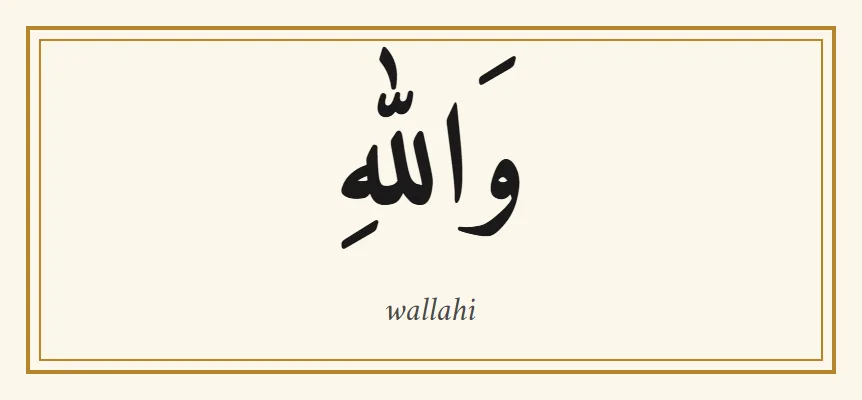
Arabic Slang > Wallahi Meaning
Wallahi (والله) means "by God", and in everyday speech it means "I swear" or "honestly". Asked as a question, wallah? means "really?". It is the oath particle wa, by, plus Allah, God. Wallah, without the final i, is the same word. It is a real oath, so save it for things you are sure of.
The image maker runs in your browser and needs JavaScript turned on.
Lettering
Colours
Size
Nothing leaves your browser; the only thing fetched is the three fonts, from Google Fonts. To letter your own text in twelve fonts, use the Arabic calligraphy generator.
Tick the vowel marks to put the kasra, the i of wallahi, under the last letter, then save the PNG.
Wallahi in Arabic letters
Wallah and wallahi are written the same way, والله, four letters with a doubled l. The final i of wallahi is a vowel mark, the kasra under the last letter, which everyday writing leaves out.
| Arabic | Transliteration | Meaning | Listen |
|---|---|---|---|
| والله | wallah, wallahi | by God; I swear; honestly; really? | |
| وَاللّٰهِ | wa-llāhi | by God, with every vowel marked | |
| بِاللّٰهِ | bi-llāhi | by God, with the oath letter bi- | |
| تَاللّٰهِ | ta-llāhi | by God, with the oath letter ta-; formal and Quranic |
Wiktionary lists bi-llāhi and ta-llāhi as synonyms of wa-llāhi. Only wa- is everyday speech. Ta- survives mostly in the Quran: we counted the exact form تالله in eight verses, among them 12:73, where Joseph's brothers protest that they did not come to steal. In chat, wallahi is sometimes cut to wlhi.
Why wallahi ends in -i
Wallahi ends in -i because the oath particle wa works like a preposition, and in Arabic the noun after a preposition takes the genitive ending -i. It is the same ending as in بِسْمِ اللّٰهِ bismillahi, in the name of God. The Quran shows the full form in 6:23, where those who worshipped others beside God say on the Day of Judgement وَٱللَّهِ رَبِّنَا, "by God, our Lord".
| Part | Arabic | Meaning |
|---|---|---|
| wa- | وَ | by (in an oath); elsewhere, and |
| Allāh | اللّٰه | God (root ʾ-l-h) |
| -i | ـِ | the genitive ending, written as a kasra mark |
| wallahi, in use | والله | I swear; honestly; really?; and as filler, a stress on what follows |
Spoken Arabic drops most case endings, so everyday speech says wallah. The -i comes back when someone wants to sound earnest: our slang page calls wallahi "the stronger form, used when someone badly wants to be believed".
How to answer wallah
Wallah has no fixed reply, because it does several jobs. As a question it wants a yes, as a Gulf greeting it wants the greeting's answer, and as an oath it wants you to accept or doubt it. The table pairs each use with an answer that fits.
| You hear | It means | You say back |
|---|---|---|
| والله؟ wallah? | really? | والله wallah, yes, really (or wallahi, to insist) |
| عنجد؟ ʿanjad? (Levantine) | seriously? | والله wallah, I swear |
| بجد؟ bi-gad? (Egyptian) | seriously? | والله wallahi, I swear |
| هلا والله hala wallah (Gulf) | hi, good to see you | هلا فيك hala fik, welcome to you |
| والله مش أنا wallahi mish ana | I swear it wasn't me | خلاص khalas, fine, settled (said with a shrug) |
Wiktionary gives both the oath and the question sense, "really?", for Modern Standard and Egyptian Arabic, and lists ʿan jadd (South Levantine) and bigadd (Egyptian) as synonyms. Hala wallah and its reply are from our everyday Arabic greetings and their replies; ʿanjad, bi-gad and khalas are from the slang table.
Wallah in the dialects, and outside Arabic
Wallah is used in every Arabic-speaking country and in Modern Standard Arabic, and our slang table rates it safe anywhere. The Gulf builds the most phrases on it.
| Where | Arabic | Transliteration | Meaning and source |
|---|---|---|---|
| Levant | والله ما بعرف | wallah ma baʿrif | honestly, I don't know (our slang table). Wiktionary spells the South Levantine word waḷḷa or waḷḷāhi |
| Egypt | والله | wallāhi | by God, I swear; really? (Wiktionary, Egyptian Arabic) |
| Gulf | صج والله | sij wallah | it's true, I swear (our slang table) |
| Saudi Arabia | كفو والله | kafu wallah | well done, honestly (our slang table) |
The word has travelled. Wiktionary records wallahi as slang in Multicultural London and Toronto English, "I swear to God". Wallah is French slang for "wow", and in German and Swedish slang it intensifies whatever follows; German probably took it through Turkish valla. Hausa and Swahili borrowed it too. In the US, "wallahi arabic meaning" draws 74,000 searches a month in Google's data fetched on 5 October 2026, more than ten times the 6,600 for "wallah meaning"; our Arabic search statistics compare the oath with the rest of this family.
Wallahi is an oath: what the sources say
Wallahi is an oath by God, and Islamic sources treat oaths with care, while separating a deliberate oath from the habitual wallah of conversation. The Quran says so in 2:225:
لَّا يُؤَاخِذُكُمُ ٱللَّهُ بِٱللَّغْوِ فِىٓ أَيْمَـٰنِكُمْ وَلَـٰكِن يُؤَاخِذُكُم بِمَا كَسَبَتْ قُلُوبُكُمْ ۗ وَٱللَّهُ غَفُورٌ حَلِيمٌ
In meaning: God does not hold you to account for the thoughtless words in your oaths, but for what your hearts intended (Quran 2:225). Sahih al-Bukhari 4613 reports ʿAʾisha saying the verse was revealed about a man's everyday لاَ وَاللَّهِ، وَبَلَى وَاللَّهِ (la wallahi, wa bala wallahi), "no, by God" and "yes, by God". Quran 5:89 repeats the rule and sets an expiation for a deliberate oath that is broken.
Why by God and not by anything else? Sahih al-Bukhari 2679 records the Prophet saying مَنْ كَانَ حَالِفًا فَلْيَحْلِفْ بِاللَّهِ أَوْ لِيَصْمُتْ: whoever swears, let him swear by God or keep silent. Quran text is copied from quran.com; hadith text from the Arabic of Sahih al-Bukhari in the numbering sunnah.com uses.
Common mistakes with wallahi
The biggest mistake is treating wallahi as filler. Wiktionary's Egyptian entry notes that overusing oaths, or using them in lies, is religiously frowned upon, and The National advises learners to say it only when they are certain of what they are saying.
Second, wallahi is not the wallah of chai wallah. That one comes from Hindi -vala, a person in charge of something, and the two words are unrelated. Third, the spelling: wallah, wallahi, walla and wlhi are all one Arabic word, والله, so do not add a letter for the i.
Wallah often comes paired with yalla, Arabic for come on and let's go, its partner in this pair of pages. For the other everyday words, see the 42 Arabic slang words and the dialects that use them. Our slang table tags wallah "everywhere", but the phrases around it change by country, and our Arabic dialect phrasebook collects them.
Frequently asked questions
What does wallahi mean?
Wallahi (والله) means by God. In everyday speech it means I swear or honestly, and asked as a question, wallah? means really? It is the oath particle wa, by, plus Allah, God. It is used in every Arabic-speaking country and in Modern Standard Arabic.
What is the difference between wallah and wallahi?
None in meaning: both are written والله. Wallahi keeps the final -i, the case ending Allah takes after the oath particle wa, and it sounds fuller and more insistent. Wallah drops it, the way spoken Arabic drops most case endings, and is the everyday form.
Is it rude or haram to say wallahi?
It is not rude, and it is said constantly. It is an oath, though, so swearing to something false is a serious matter, and Wiktionary's Egyptian Arabic entry notes that overusing oaths, or using them in lies, is religiously frowned upon. Use it when you are sure.
How do you reply to wallah?
It depends on how it is used. Asked as wallah? (really?), answer wallah (yes, really) to confirm. In the Gulf, hala wallah means hi, good to see you, and the reply is hala fik. When someone swears wallahi to settle a doubt and you believe them, khalas, fine, settles it.
Is wallahi the same as the wallah in chai wallah?
No. The wallah of chai wallah or box wallah comes from Hindi -vala, a person in charge of something. Wallahi, by God, is Arabic. Wiktionary lists them as two unrelated words that happen to sound alike in English.