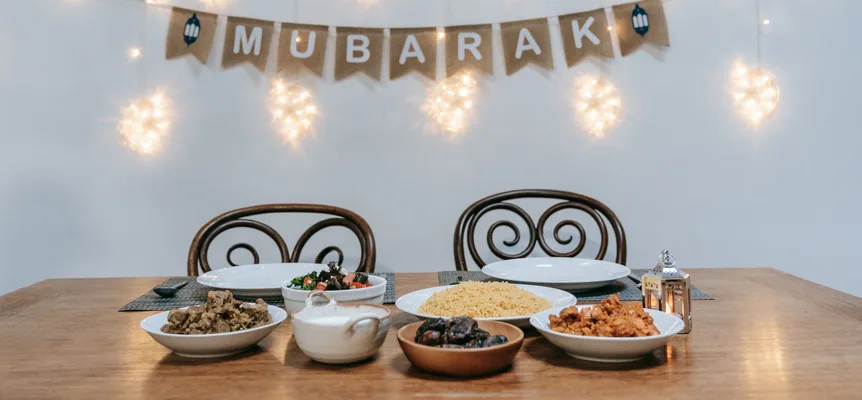
Common Arabic Phrases > Eid Mubarak
Eid Mubarak, عيد مبارك (ʿid mubarak), means "blessed feast" in Arabic. Muslims say it on both Eids: Eid al-Fitr, which ends Ramadan, and Eid al-Adha, which falls during the Hajj. The usual answer is the same words back, or taqabbal Allahu minna wa minkum, "may God accept from us and from you".
Make a card with it below. Pick a greeting, add a name in English or Arabic letters, choose a design and download the PNG. Every greeting in the list is spelled the way our Islamic phrases with their replies spells it.
The card maker runs in your browser and needs JavaScript turned on.
1. Pick a greeting
3. Design
4. Lettering
5. Size
Nothing you type leaves your browser; the only thing fetched is the three fonts, from Google Fonts. For other lettering styles and your own text, use the Arabic calligraphy generator.
Transliteration on this page follows that Islamic phrases page: ʿ is the letter ع, a squeeze in the throat, ʾ is a glottal stop, and long vowels carry no mark. Forms said to one person are masculine.
Eid greetings by region, and the reply each one expects
The greeting heard everywhere is ʿid mubarak, but each region adds its own, and each of those has a fixed answer. The Gulf rows come from The National's 2026 guide to Eid greetings, the Egyptian row from the Lisaan Masry list of courtesy formulas, which files it under feasts, and the Lebanese rows from the Lebanese Arabic Institute's Eid al-Fitr greetings.
| Region | Arabic | Transliteration | Meaning | Expected reply |
|---|---|---|---|---|
| Everywhere | عيد مبارك | ʿid mubarak | blessed feast | the same back, or taqabbal Allahu minna wa minkum |
| Everywhere | تقبل الله منا ومنكم | taqabbal Allahu minna wa minkum | may God accept from us and from you | the same phrase returned |
| Everywhere, formal | كل عام وأنتم بخير | kull ʿam wa antum bi-khayr | may you be well every year | wa antum bi-khayr, and you too |
| Everywhere, casual | عيد سعيد | ʿid saʿid | happy Eid | no fixed reply; The National suggests keeping it for younger people |
| Gulf | عساكم من عواده | ʿasakum min ʿuwwadah | may you live to see it come round again | the same back |
| Gulf | من العايدين والفايزين | min al-ʿayidin wa-l-faʾizin | among those who return and win | min al-maqbulin wa-l-ghanimin, among the accepted and the rewarded |
| Egypt | كل سنة وانت طيب | kull sana w-inta tayyib (to a woman: w-inti tayyiba) | every year, and you are well | w-inta tayyib, and you too |
| Lebanon and the Levant | كل عام وإنت بخير | kill ʿam w-inta b-khayr | well every year | w-inta b-alf khayr وإنت بألف خير and you a thousand times well |
| Morocco | عواشر مبروكة | ʿawashir mabruka | blessed days | Allah yibarik fik الله يبارك فيك God bless you |
Use the first three anywhere. They are Modern Standard Arabic, so they read correctly on a card sent to Rabat or to Riyadh, and the card maker above offers all three. The regional rows are what you will hear in the street; answer each with the reply beside it. The Moroccan greeting is not only for Eid: IslamOnline's report on Ramadan in Morocco says Moroccans say عواشر مبروكة before, during and after Ramadan. Our Arabic wishes for every occasion, with replies has the same pairs for birthdays, weddings and condolences.
Eid al-Fitr and Eid al-Adha, side by side
Islam has two Eids, and Eid Mubarak works for both. Eid al-Fitr, the feast of breaking the fast, is the first day of Shawwal and ends Ramadan. Eid al-Adha, the feast of the sacrifice, is the tenth of Dhu al-Hijjah, during the Hajj, about ten weeks later. Dates and lengths below are from Wikipedia's articles on Eid al-Fitr and Eid al-Adha, and the 2027 dates from the Umm al-Qura calendar.
| Eid al-Fitr | Eid al-Adha | |
|---|---|---|
| Arabic | عيد الفطر | عيد الأضحى |
| Transliteration and meaning | ʿid al-fitr, feast of breaking the fast | ʿid al-adha, feast of the sacrifice |
| Hijri date | 1 Shawwal | 10 Dhu al-Hijjah |
| 2027, by Umm al-Qura | Tuesday 9 March 2027 | Sunday 16 May 2027 |
| What it marks | the end of the month of fasting | Abraham's readiness to sacrifice his son; the Hajj |
| How long | one to three days, depending on the country | four days: the day itself and the three days of tashriq |
| Other names | the Lesser Eid; Ramazan Bayramı or Şeker Bayramı in Turkish; Idulfitri or Lebaran in Indonesian | the Greater Eid, العيد الكبير (al-ʿid al-kabir); Kurban Bayramı in Turkish |
| What people add to ʿid mubarak | taqabbal Allahu minna wa minkum, which also closes Ramadan | ʿasakum min ʿuwwadah in the Gulf, the greeting in The National's Eid al-Adha guide |
The 2027 dates are planning dates. Where the month starts on a local sighting of the new moon, either Eid can move by a day or two. Our Islamic calendar 2027, with printable PDFs lists every key date of the year and the ten years after it. Eid al-Fitr comes the day after the last fast, so for the month before it see when Ramadan 2027 starts, with fasting times for your city.
How Muslims who do not speak Arabic say Eid Mubarak
Most say Eid Mubarak itself, in their own spelling, and add a greeting in their own language. Urdu and Persian speakers write the same two words with Persian letters. Turkish and Indonesian have greetings of their own, and one of the Indonesian ones is Arabic.
| Language | Greeting | Meaning | Note |
|---|---|---|---|
| Turkish | Bayramınız kutlu olsun | may your holiday be blessed | formal. Reply: Sizin de bayramınız kutlu olsun, may yours be blessed too (Kaiwa) |
| Turkish | İyi bayramlar | happy holiday | casual, between friends (Kaiwa) |
| Indonesian | Minal aidin wal faizin | among those who return and win | Eid al-Fitr; often followed by mohon maaf lahir dan batin, forgive our wrongs in body and heart (Wiktionary) |
| Indonesian | Selamat Idul Fitri, Selamat Lebaran | happy Eid al-Fitr | Wiktionary, selamat |
| Malay | Selamat Hari Raya | happy Eid al-Fitr | Wiktionary, selamat |
| Urdu | عید مبارک (ʿid mubarak) | blessed feast | the Arabic phrase in Urdu letters (Wiktionary) |
| Persian | عید مبارک (ʿeyd mobarak) | blessed feast | same spelling as Urdu, said with Persian vowels (Wiktionary) |
Minal aidin wal faizin is the Gulf greeting min al-ʿayidin wa-l-faʾizin from the regional table, spelled the Indonesian way, and Wiktionary traces it to the Arabic. The Urdu and Persian عید مبارک and the Arabic عيد مبارك are not the same characters. Urdu and Persian use their own forms of ya (ی, no dots at the end of a word) and kaf (ک). A keyboard set to Urdu or Persian types those letters, so an Arabic greeting typed on one looks right but is not Arabic text. The card maker above always writes the Arabic letters.
What Eid Mubarak means, word by word
Eid Mubarak is two words: ʿid, a feast or holiday, and mubarak, blessed. ʿId is the same word that starts ʿid milad saʿid, happy birthday, which is literally "happy feast of birth". Wiktionary's entry for mubarak gives it as the passive participle of بارك (baraka), to bless, from the root b-r-k.
The same root gives baraka, blessing, and mabruk, congratulations, and the same mubarak appears in Ramadan Mubarak, the greeting for the month before Eid al-Fitr. To practise ʿid, mubarak and the other words of the season, play the Ramadan and Eid set in our free Arabic word-building and memory games.
Frequently asked questions
What does Eid Mubarak mean?
Eid Mubarak (عيد مبارك, ʿid mubarak) means blessed feast. ʿId is a feast or holiday, and mubarak is blessed, the passive participle of the verb baraka, to bless, from the root b-r-k. Muslims say it on both Eids: Eid al-Fitr, which ends Ramadan, and Eid al-Adha, which falls during the Hajj.
Is Eid Mubarak the same as Ramadan Mubarak?
No. Ramadan Mubarak, blessed Ramadan, is said during the month of fasting. Eid Mubarak is said on the feast that ends it, Eid al-Fitr, and again about ten weeks later on Eid al-Adha. Switch from one to the other on Eid morning. In 2027, by the Umm al-Qura calendar, that is Tuesday 9 March.
How do you reply to Eid Mubarak?
Say Eid Mubarak back, or answer taqabbal Allahu minna wa minkum (تقبل الله منا ومنكم), may God accept from us and from you. Regional greetings have their own replies: in the Gulf, min al-ʿayidin wa-l-faʾizin is answered min al-maqbulin wa-l-ghanimin, and in Lebanon kill ʿam w-inta b-khayr is answered w-inta b-alf khayr.
Can non-Muslims say Eid Mubarak?
Yes. Muslims hear it from colleagues, neighbours and friends of every background, and it is the normal way for anyone to greet a Muslim on the day. Say it on the day of Eid or in the days that follow. If you want the most neutral form, kull ʿam wa antum bi-khayr, may you be well every year, works for any yearly celebration.