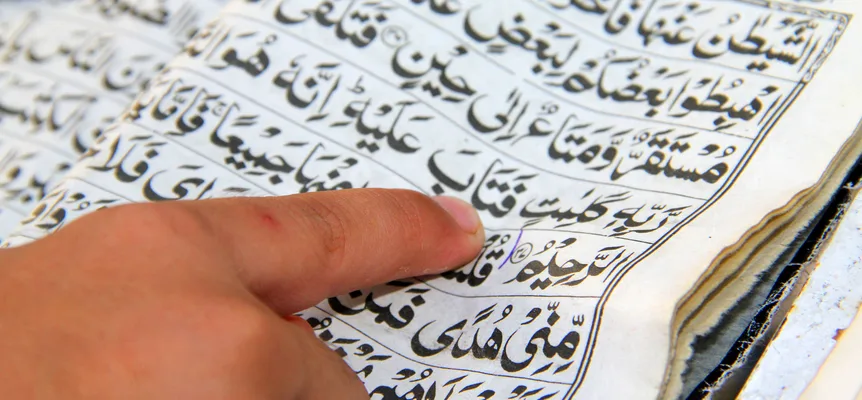
Learn Quranic Arabic > Tajweed Rules
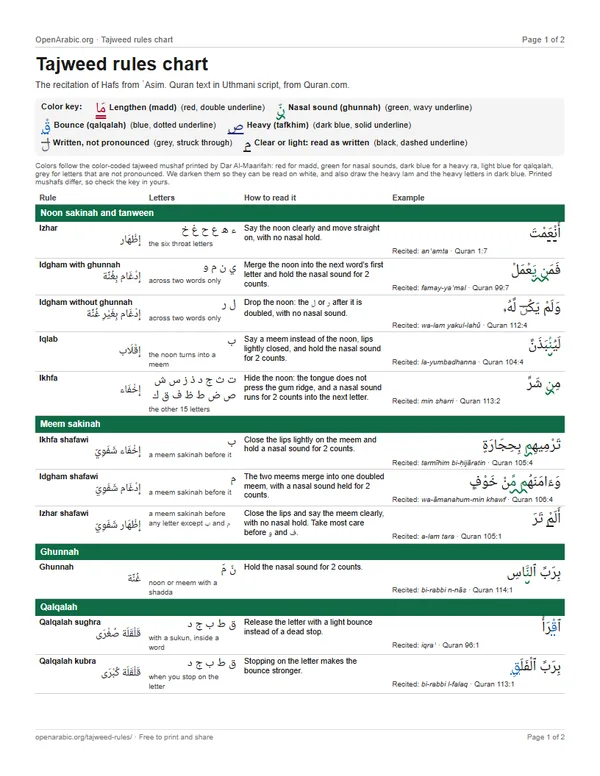
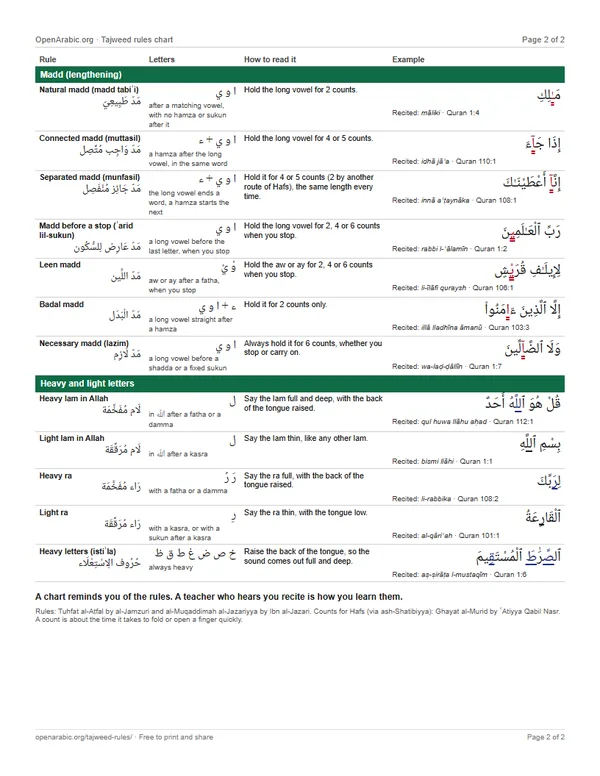
Tajweed rules are the rules for pronouncing the Quran when it is recited: how a noon or meem with a sukun changes before the next letter, which letters bounce, how long a long vowel is held, and which letters are heavy. The chart below sets out 23 rules for the Hafs recitation, each with a colored Quran example.
- Lengthen (madd) (red, double underline)
- Nasal sound (ghunnah) (green, wavy underline)
- Bounce (qalqalah) (blue, dotted underline)
- Heavy (tafkhim) (dark blue, solid underline)
- Written, not pronounced (grey, struck through)
- Clear or light: read as written (black, dashed underline)
Colors follow the color-coded tajweed mushaf printed by Dar Al-Maarifah: red for madd, green for nasal sounds, dark blue for a heavy ra, light blue for qalqalah, grey for letters that are not pronounced. We darken them so they can be read on white, and also draw the heavy lam and the heavy letters in dark blue. Printed mushafs differ, so check the key in yours.
-
Clear or light: read as written
Letters: ء ه ع ح غ خ the six throat letters
Say the noon clearly and move straight on, with no nasal hold.
أَنْعَمْتَ
Recited: anʿamta · Quran 1:7
-
Nasal sound (ghunnah)
Letters: ي ن م و across two words only
Merge the noon into the next word's first letter and hold the nasal sound for 2 counts.
فَمَن يَعْمَلْ
Recited: famay-yaʿmal · Quran 99:7
-
Written, not pronounced
Letters: ل ر across two words only
Drop the noon: the ل or ر after it is doubled, with no nasal sound.
وَلَمْ يَكُن لَّهُۥ
Recited: wa-lam yakul-lahū · Quran 112:4
-
Nasal sound (ghunnah)
Letters: ب the noon turns into a meem
Say a meem instead of the noon, lips lightly closed, and hold the nasal sound for 2 counts.
لَيُنۢبَذَنَّ
Recited: la-yumbadhanna · Quran 104:4
-
Nasal sound (ghunnah)
Letters: ت ث ج د ذ ز س ش ص ض ط ظ ف ق ك the other 15 letters
Hide the noon: the tongue does not press the gum ridge, and a nasal sound runs for 2 counts into the next letter.
مِن شَرِّ
Recited: min sharri · Quran 113:2
-
Nasal sound (ghunnah)
Letters: ب a meem sakinah before it
Close the lips lightly on the meem and hold a nasal sound for 2 counts.
تَرْمِيهِم بِحِجَارَةٍ
Recited: tarmīhim bi-ḥijāratin · Quran 105:4
-
Nasal sound (ghunnah)
Letters: م a meem sakinah before it
The two meems merge into one doubled meem, with a nasal sound held for 2 counts.
وَءَامَنَهُم مِّنْ خَوْفٍۭ
Recited: wa-āmanahum-min khawf · Quran 106:4
-
Clear or light: read as written
Letters: a meem sakinah before any letter except ب and م
Close the lips and say the meem clearly, with no nasal hold. Take most care before و and ف.
أَلَمْ تَرَ
Recited: a-lam tara · Quran 105:1
-
Nasal sound (ghunnah)
Letters: نّ مّ noon or meem with a shadda
Hold the nasal sound for 2 counts.
بِرَبِّ ٱلنَّاسِ
Recited: bi-rabbi n-nās · Quran 114:1
-
Bounce (qalqalah)
Letters: ق ط ب ج د with a sukun, inside a word
Release the letter with a light bounce instead of a dead stop.
ٱقْرَأْ
Recited: iqraʾ · Quran 96:1
-
Bounce (qalqalah)
Letters: ق ط ب ج د when you stop on the letter
Stopping on the letter makes the bounce stronger.
بِرَبِّ ٱلْفَلَقِ
Recited: bi-rabbi l-falaq · Quran 113:1
-
Lengthen (madd)
Letters: ا و ي after a matching vowel, with no hamza or sukun after it
Hold the long vowel for 2 counts.
مَـٰلِكِ
Recited: māliki · Quran 1:4
-
Lengthen (madd)
Letters: ا و ي + ء a hamza after the long vowel, in the same word
Hold the long vowel for 4 or 5 counts.
إِذَا جَآءَ
Recited: idhā jāʾa · Quran 110:1
-
Lengthen (madd)
Letters: ا و ي + ء the long vowel ends a word, a hamza starts the next
Hold it for 4 or 5 counts (2 by another route of Hafs), the same length every time.
إِنَّآ أَعْطَيْنَـٰكَ
Recited: innā aʿṭaynāka · Quran 108:1
-
Lengthen (madd)
Letters: ا و ي a long vowel before the last letter, when you stop
Hold the long vowel for 2, 4 or 6 counts when you stop.
رَبِّ ٱلْعَـٰلَمِينَ
Recited: rabbi l-ʿālamīn · Quran 1:2
-
Lengthen (madd)
Letters: وْ يْ aw or ay after a fatha, when you stop
Hold the aw or ay for 2, 4 or 6 counts when you stop.
لِإِيلَـٰفِ قُرَيْشٍ
Recited: li-īlāfi quraysh · Quran 106:1
-
Lengthen (madd)
Letters: ء + ا و ي a long vowel straight after a hamza
Hold it for 2 counts only.
إِلَّا ٱلَّذِينَ ءَامَنُوا۟
Recited: illā lladhīna āmanū · Quran 103:3
-
Lengthen (madd)
Letters: ا و ي a long vowel before a shadda or a fixed sukun
Always hold it for 6 counts, whether you stop or carry on.
وَلَا ٱلضَّآلِّينَ
Recited: wa-laḍ-ḍāllīn · Quran 1:7
-
Heavy (tafkhim)
Letters: ل in ٱللَّه after a fatha or a damma
Say the lam full and deep, with the back of the tongue raised.
قُلْ هُوَ ٱللَّهُ أَحَدٌ
Recited: qul huwa llāhu aḥad · Quran 112:1
-
Clear or light: read as written
Letters: ل in ٱللَّه after a kasra
Say the lam thin, like any other lam.
بِسْمِ ٱللَّهِ
Recited: bismi llāhi · Quran 1:1
-
Heavy (tafkhim)
Letters: رَ رُ with a fatha or a damma
Say the ra full, with the back of the tongue raised.
لِرَبِّكَ
Recited: li-rabbika · Quran 108:2
-
Clear or light: read as written
Letters: رِ with a kasra, or with a sukun after a kasra
Say the ra thin, with the tongue low.
ٱلْقَارِعَةُ
Recited: al-qāriʿah · Quran 101:1
-
Heavy (tafkhim)
Letters: خ ص ض غ ط ق ظ always heavy
Raise the back of the tongue, so the sound comes out full and deep.
ٱلصِّرَٰطَ ٱلْمُسْتَقِيمَ
Recited: aṣ-ṣirāṭa l-mustaqīm · Quran 1:6
Hafs from ʿAsim. Quran text: Uthmani script from Quran.com. 23 rules.
Download the tajweed rules chart as a PDF (126 KB, 2 pages). It has the same 23 rules, colors and Quran examples as the chart above, prints on US Letter paper, and prints on A4 with fit to page. There is no sign-up. Each color also has its own kind of underline, so the chart still works on a black-and-white printer.
How to read the chart
Each card gives one rule, the letters that trigger it, what to do with your voice, and a Quran example in which the letters the rule changes are colored and underlined. Below the example it is written in Latin letters the way it is recited, with merged letters and stops written out, and linked to its verse on Quran.com, where you can listen to it and read a translation. Tap a group to show only its rules, or a rule's name to mark its letters. Test yourself hides every color until you tap a rule.
The colors follow the key of the color-coded tajweed mushaf printed by Dar Al-Maarifah, which describes its colors this way: red for letters held longer, green for nasal letters, dark blue for the heavy ra, light blue for the qalqalah bounce, and grey for letters that are written but not pronounced. We darken each color so it can be read on white, and we also draw the heavy lam of Allah and the seven heavy letters in dark blue, which that key does not. Printed mushafs differ, so when you read from your own copy, use the key printed in it. Each category also has its own underline (double, wavy, dotted, solid, struck through or dashed) and a label on the card.
A count, the unit of every length on the chart, is about the time it takes to fold or open a finger quickly: a quarter to a third of a second, as defined in ʿAtiyya Qabil Nasr's tajweed textbook Ghayat al-Murid, cited in the Arabic Wikipedia article on ghunnah. The chart follows the recitation of Hafs from ʿAsim, the text of Quran.com that every example was copied from on 15 October 2026. Other recitations differ: in Warsh by the route of al-Azraq, for example, the connected and separated madd are both held for 6 counts.
Noon sakinah and tanween: four rules
A noon with a sukun (نْ) or a tanween (ـً ـٍ ـٌ, the doubled vowel marks that end a word in an n sound) is read in one of four ways, decided by the letter after it. Every letter of the alphabet falls under exactly one of the four, and the 18th-century teaching poem Tuhfat al-Atfal by Sulayman al-Jamzuri gives each group a memory aid.
| Rule | Letters after the noon | Memory aid | What you do |
|---|---|---|---|
| Izhar إِظْهَار (clear) | ء ه ع ح غ خ (hamza, hāʾ, ʿayn, ḥāʾ, ghayn, khāʾ) | The six letters of the throat | Say the n clearly, with no nasal hold |
| Idgham إِدْغَام (merging) | ي ر م ل و ن | يرملون (yarmalūn) | Merge the n into the next letter: with a nasal hold before ي ن م و (ينمو, yanmū), with none before ل ر |
| Iqlab إِقْلَاب (turning) | ب (bāʾ) | One letter | Say m instead of n, with a nasal hold |
| Ikhfa إِخْفَاء (hiding) | The other 15: ت ث ج د ذ ز س ش ص ض ط ظ ف ق ك | The first letters of the words of the line صِفْ ذَا ثَنَا كَمْ جَادَ شَخْصٌ قَدْ سَمَا دُمْ طَيِّبًا زِدْ فِي تُقًى ضَعْ ظَالِمَا | Hide the n in a nasal sound that runs into the next letter |
Six, six, one and fifteen make 28: the whole alphabet, with hamza counted as a letter. In the chart, أَنْعَمْتَ (anʿamta, 1:7) keeps its noon clear before ʿayn, and مِن شَرِّ (min sharri, 113:2) hides it before shīn.
Idgham happens only between two words. Inside one word the noon stays clear even before ي or و, and the poem names the cases: ٱلدُّنْيَا (ad-dunyā, 87:16) and صِنْوَانٌ (ṣinwānun, 13:4) are read with a full n. Quran.com's tajweed marking leaves both unmarked too.
Meem sakinah: three rules
A meem with a sukun (مْ) has three rules, again set by the next letter. Before ب it is hidden with a nasal hold (ikhfa shafawi, the lip rule: تَرْمِيهِم بِحِجَارَةٍ, 105:4). Before another م the two merge into one doubled meem (idgham shafawi: وَءَامَنَهُم مِّنْ خَوْفٍۭ, 106:4). Before every other letter it is said clearly with closed lips (izhar shafawi: أَلَمْ تَرَ, 105:1).
Tuhfat al-Atfal adds one warning to this group: take care not to hide the meem before و (wāw) and ف (fāʾ). The poem gives the reason: wāw is made in the same place as meem, and fāʾ close to it.
Ghunnah: the doubled noon and meem
A noon or a meem with a shadda (نّ مّ) is always read with a ghunnah, a nasal sound from the nose held for 2 counts, as in بِرَبِّ ٱلنَّاسِ (bi-rabbi n-nās, 114:1). The same nasal sound comes in five other rules on the chart, the green ones: idgham with ghunnah, iqlab, ikhfa, ikhfa shafawi and idgham shafawi.
To check that your ghunnah comes from the nose, pinch your nose while you hold it. The Arabic Wikipedia article on ghunnah gives the test: with the nose closed the ghunnah stops.
Qalqalah: the five bouncing letters
Five letters bounce when they carry a sukun: qāf ق, ṭāʾ ط, bāʾ ب, jīm ج and dāl د. Ibn al-Jazari gathers them in the two words قطب جد in his teaching poem al-Muqaddimah al-Jazariyya, and says the bounce is clearer when you stop on the letter.
The chart uses two names for the two strengths in that line. Qalqalah sughra, the small bounce, is a letter with a sukun inside a word or joined to the next one, like the qāf of ٱقْرَأْ (iqraʾ, 96:1). Qalqalah kubra, the big bounce, is a letter you stop on, like the last qāf of بِرَبِّ ٱلْفَلَقِ (al-falaq, 113:1). The Wikipedia articles on qalqalah, in Arabic and in English, split the stop into two degrees: the strongest bounce is a stop on a letter with a shadda, such as وَتَبَّ (wa-tabb, 111:1), the example both give.
Madd: how many counts to hold a long vowel
Madd is the lengthening of a long vowel, written with ا, و or ي. On its own a long vowel lasts 2 counts. A hamza or a sukun after it, and in one case a hamza before it, sets a different length. Tuhfat al-Atfal sorts the kinds as obligatory, permitted and necessary. The counts below are those of Hafs by the route of ash-Shatibiyya, from the Arabic Wikipedia article on the rules of madd, which follows Ghayat al-Murid.
| Madd | When | Counts (Hafs) | Example on the chart |
|---|---|---|---|
| Natural, مَدّ طَبِيعِيّ (madd ṭabīʿī) | Nothing after the long vowel changes it | 2 | مَـٰلِكِ (māliki, 1:4) |
| Connected, مَدّ مُتَّصِل (muttaṣil) | A hamza after it in the same word | 4 or 5 | إِذَا جَآءَ (jāʾa, 110:1) |
| Separated, مَدّ مُنْفَصِل (munfaṣil) | It ends a word and the next word starts with a hamza | 4 or 5 (2 is also read, by the route of Tayyibat al-Nashr) | إِنَّآ أَعْطَيْنَـٰكَ (innā aʿṭaynāka, 108:1) |
| Before a stop, مَدّ عَارِض لِلسُّكُون (ʿāriḍ lil-sukūn) | You stop on the next letter | 2, 4 or 6 | رَبِّ ٱلْعَـٰلَمِينَ (al-ʿālamīn, 1:2) |
| Leen, مَدّ اللِّين (līn) | You stop after aw or ay | 2, 4 or 6 | لِإِيلَـٰفِ قُرَيْشٍ (quraysh, 106:1) |
| Badal, مَدّ الْبَدَل | A hamza comes just before the long vowel | 2 | إِلَّا ٱلَّذِينَ ءَامَنُوا۟ (āmanū, 103:3) |
| Necessary, مَدّ لَازِم (lāzim) | A shadda or a sukun that never goes, after it | 6 | وَلَا ٱلضَّآلِّينَ (aḍ-ḍāllīn, 1:7) |
Heavy and light letters
Seven letters are always heavy: خ ص ض غ ط ق ظ (khāʾ, ṣād, ḍād, ghayn, ṭāʾ, qāf, ẓāʾ), which Ibn al-Jazari gathers in the words خص ضغط قظ. Two letters change: ra, and the lam in the name Allah. Every other letter is light. A heavy letter is said with the back of the tongue raised, so the sound comes out full and deep. Our guide to the Arabic sounds English speakers find hard shows how to make the four emphatic letters.
Ra is heavy with a fatha or a damma, as in لِرَبِّكَ (li-rabbika, 108:2), and light with a kasra, as in ٱلْقَارِعَةُ (al-qāriʿah, 101:1). A ra with a sukun takes the vowel before it: after a kasra it is light, unless a heavy letter comes after it or the kasra is not part of the word itself (both exceptions are in al-Muqaddimah al-Jazariyya). After a fatha or a damma it is heavy, as at the stop in وَٱلْعَصْرِ (wal-ʿaṣr, 103:1), the example the English Wikipedia article gives.
The lam of Allah is heavy after a fatha or a damma, as in قُلْ هُوَ ٱللَّهُ أَحَدٌ (qul huwa llāhu aḥad, 112:1), and light after a kasra, as in بِسْمِ ٱللَّهِ (bismi llāhi, 1:1).
The lam of the article al- before a sun letter is the most common silent letter: it is written but not said, which is why the color-coded mushaf prints it in grey. Our page on sun and moon letters sorts all 28 letters.
Common tajweed mistakes
Most beginner mistakes come from applying a rule where it does not belong, or from letting a length drift. The sources above warn against these five:
- Merging a noon inside one word. Idgham is only between two words, so ٱلدُّنْيَا keeps its n.
- Hiding the meem before wāw or fāʾ. Before و and ف the meem is said clearly with closed lips.
- Turning the qalqalah bounce into a vowel. Wikipedia describes the bounce as a reduced vowel, a short echo, so iqraʾ must not become iqara.
- Changing the length of the same madd. The Arabic Wikipedia article on madd says every madd of one kind is held the same through a recitation: if the separated madd gets 4 counts once, it gets 4 every time.
- Reading a color as a rule. The colors are each printer's own key, so learn the rule and check the key of each mushaf you use.
Learn the sounds from a teacher
A chart tells you what a rule is. It cannot tell you whether you are doing it, because the rules are about sounds and you cannot hear your own mistakes. The owner's account of learning Arabic as an adult describes that order: reading first, then the rules, from a tutor. In its words, "As my reading speed increased, my tutor introduced different tajweed rules", and "we used a Quran with special color-coding" to practise them.
If your reading is still slow, start with how to read Arabic, with a reading drill and the vowel marks in our guide to Arabic diacritics. For a teacher, our comparison of online Quran classes by price per hour lists 11 providers. Tajweed covers how the Quran sounds. For what it means, see how to learn Quranic Arabic and the Quran root words explorer.
Sources
The rules and their letters come from two teaching poems, read on Arabic Wikisource. The counts come from the Arabic Wikipedia articles named above, and the Quran text from Quran.com:
- Sulayman al-Jamzuri, Tuhfat al-Atfal (completed 1198 AH): noon sakinah and tanween, ghunnah, meem sakinah, the kinds of madd.
- Ibn al-Jazari, al-Muqaddimah al-Jazariyya: qalqalah, the heavy letters, ra, the lam of Allah.
- ʿAtiyya Qabil Nasr, Ghayat al-Murid fi ʿIlm al-Tajwid (7th edition, 1992), as cited by the Arabic Wikipedia articles on the rules of madd and on ghunnah: the counts for Hafs.
- English Wikipedia, Tajwid, which cites Kristina Nelson's The Art of Reciting the Qur'an, and Arabic Wikipedia, qalqalah: the degrees of qalqalah and the example of the heavy ra.
- Quran.com: every Quran example, copied from its Uthmani text. We checked each example's colored letters against Quran.com's own tajweed marking wherever it marks that rule.
Frequently asked questions
How many tajweed rules are there?
There is no fixed number. Beginner books group the rules by the letter or sound they affect: four for noon sakinah and tanween, three for meem sakinah, the ghunnah of a doubled noon or meem, qalqalah, the kinds of madd, and heavy and light letters. Counted that way, our chart has 23 rules for the recitation of Hafs. Longer books add the rules for stopping and starting and the points of articulation of each letter.
What do the colors in a tajweed Quran mean?
In the color-coded tajweed mushaf printed by Dar Al-Maarifah, red marks letters that are lengthened (madd), green marks nasal sounds (ghunnah), dark blue marks a heavy ra, light blue marks the qalqalah bounce, and grey marks letters that are written but not pronounced. Other printers use other colors, so check the key printed in your copy.
What are the five qalqalah letters?
ق ط ب ج د: qāf, ṭāʾ, bāʾ, jīm and dāl. Ibn al-Jazari gathers them in the two words قطب جد in his poem al-Muqaddimah al-Jazariyya. They bounce when they carry a sukun: lightly inside a word, and more strongly when you stop on them.
How long is one count in madd?
One count (haraka) is about the time it takes to fold or open a finger quickly, a quarter to a third of a second, as ʿAtiyya Qabil Nasr defines it in his tajweed textbook Ghayat al-Murid. In the recitation of Hafs a natural madd is 2 counts, a connected madd 4 or 5, and a necessary madd 6.
Can I learn tajweed from a chart?
You can learn what each rule is, and a chart is a good reminder while you read. You cannot check your own pronunciation with it. The rules are about sounds, and a teacher who hears you recite corrects what you cannot hear yourself. On 14 October 2026 the online Quran classes we compared charged from $6.25 to $10 for a private hour of reading or tajweed.